How do you build a sustainable career in unsustainable times? This is the question we’re answering together in this episode. I discuss a framework to help us as working women and mothers set and keep a career we can sustain and thrive in over the years and through the many seasons of womanhood.
Take a listen!
Thanks for Listening!
Thanks so much for tuning in and listening to this week’s episode! If you enjoyed this week’s episode, please share it by using the social media at the bottom of this post!
Also, leave me a review for the TCS podcast on Apple Podcasts !
The start of the year is supposed to feel like a career reset. New goals. New momentum. New clarity about where you’re headed professionally. And the hope that last year is behind you and this one will be better, or at least different.
Yet, for many women, January doesn’t feel like a fresh professional start at all. Rather, it often feels like picking up exactly where things were left, what with unfinished conversations, delayed progress, and unresolved tension around work.
Because the reality is, women’s careers don’t reset just because the calendar does.
Compensation that never fully caught up to expanded responsibilities.
Career pauses taken for valid reasons—but quietly penalized.
Leadership roles accepted with more risk and visibility, but not more authority or protection.
These experiences are not individual failures. They are patterns.
Across industries, women continue to earn less, advance more slowly, and carry greater career risk than men, even as their education levels and performance remain high.
What this means in practice is simple but consequential: many women start the new year from a weaker professional position than they should.
Why Career Position Compounds Over Time
When women enter a new year already behind, the gap doesn’t stay static. It widens, for the simple reason that careers are cumulative.
Early delays in pay growth affect every raise that follows. Missed promotions don’t just stall titles, they stall access to influence, visibility, and future opportunities. Gaps in leadership roles shape who is seen as “ready” next time.
This is why women often feel pressure earlier, from the pressure to perform, to prove, to the pressure to stabilize, because their margin for error is smaller.
It’s not about confidence or ambition. It’s about leverage.
Why This Isn’t a Personal Career Failure
When similar career patterns show up across sectors, in the form of women advancing more slowly, being paid less for comparable work, or leaving roles at higher rates, that’s not coincidence.
It’s design.
Career systems often reward uninterrupted trajectories, linear progression, and constant availability. These are models that still map more easily onto men’s lives than women’s. While women strive to adapt and make this model work, the reality is that adaptation without reinforcement isn’t sustainable. And over time, it leads to stagnation, attrition, or quiet disengagement, not because women lack commitment, but because the cost becomes too expensive.
A More Effective Way to Think About Career “Resets”
Instead of treating January as a professional reset, what if we treated it as a career reckoning?
What if we took it as an opportunity to ask:
What progress was delayed last year?
What responsibilities expanded without corresponding authority or pay?
What conversations didn’t happen, but should have?
These questions can in turn prompt women to build career sustainability by working more strategically instead of working harder.
If this resonated with you, here are a few steps that you can take to improve your career in 2026:
1. Take stock of your professional position Before setting new goals, assess where you actually stand, in terms of title, pay, scope, influence. Clarity here is foundational.
2. Re-anchor your value If your responsibilities grew faster than your compensation or authority, that’s not gratitude, that’s misalignment. Address it.
3. Prioritize roles that build leverage Look for opportunities that expand decision-making power, visibility, and future optionality, not just workload.
4. Stop confusing endurance with advancement Holding things together is not the same as moving forward. Stability is valuable, but it should not replace progression.
5. Give yourself permission to course-correct You don’t need burnout or a breaking point to justify change. Wanting more alignment is reason enough.
Here’s to Starting your Professional Year Strong…
This year, instead of asking: What do I want to accomplish in my career?
Try asking: What professional imbalance do I need to address first?
Because careers don’t change through intention alone. They change through alignment between effort, reward, authority, and opportunity.
At the Corporate Sister, the Career pillar is about exactly this: helping women build careers that are not only impressive, but sustainable and fair.
Here’s to a year of clearer career positioning, stronger professional footing, and progress that finally feels proportional to the work you do.
It’s year-end again, and here we are steeped in year-end deadlines, holiday shopping, festivities planning, and…year-end performance review time at work. If you’ve ever wondered why year-end feels like an exhausting test on the home and work front, you are far from being alone.
For years, I thought I was the only one feeling overwhelmed by December’s competing demands, from the home to the office. Yet, as it turns out, the feelings so many of us experience, from being tired, stretched thin, to being pulled in opposite directions, are not personal shortcomings. They’re deeply rooted in the way our society relies on women without valuing their contributions…
Indeed, every December, while juggling and being judged on invisible holiday labor, women are also expected to walk into performance conversations well-rested, confident, emotionally grounded, and ready to self-advocate. In other words, they are judged on two fronts during the same period, the personal and the professional, at home and at work…
On one hand, the (Visible) year-end performance review…
If you’ve dreaded having to lay down an entire year of accomplishments, but also misses and opportunities for improvement on paper, and then discussing them at a formal, semi-sweet-and-sour meeting with undertones of feedback sandwiches, you’re one of many working women who have felt this way. And it’s not coincidental…
Studies from the Harvard Business Review show women receive more subjective and personality-based feedback than men. Words like “tone,” “attitude,” or “being more confident” tend to pervade women’s reviews. Additionally, women’s accomplishments are often described in vague, non-specific language, making it harder to translate praise into promotions or raises. And when women come into reviews emotionally depleted (as many are during December), this compounds self-doubt and reduces the kind of confident self-advocacy workplaces expect.
It’s a mismatch. A quiet, structural mismatch.The kind women feel in their bones but rarely name.
On the other hand, the holiday labor review we never signed up for…
As offices gear for annual performance reviews, working women quietly take on a second full-time job for which they are also ruthlessly, and quietly, evaluated. Think of it as the holiday labor review. While the world celebrates the season’s joy and sparkle, women often absorb the planning, coordinating, smoothing, managing, checking-in, remembering, and keeping-the-peace.
We call it tradition. We even name it love. Yet, reality is that what it is is, unpaid emotional and cognitive labor. And research confirms it…
For decades, sociologists and time‑use researchers have found that women shoulder the vast majority of the emotional and cognitive labor of family life, and that this burden intensifies around family‑intensive seasons such as holidays. December, especially, becomes a month where women carry not just the logistics of holidays—but the feelings of everyone involved.
All while holding down our actual jobs, and being silently evaluated on it. No wonder so many women reach the end of the year already running on fumes.
Two Reviews, One Season: Why Year-End Often Feels Too Heavy…
When you put the research and lived experience together, the picture becomes painfully clear:
Women are carrying two evaluation seasons at once: one at home that nobody calls a “review,” and one at work that everybody does.
At home, you’re responsible for orchestrating joy, connection, memory, and meaning.
At work, you’re responsible for articulating competence, value, clarity, leadership, direction, and growth.
And still, too often, women walk into both systems under-recognized, under-supported, and overwhelmed.
It is not that women lack resilience. It’s that women are navigating a system not built with their load in mind.
So What Can We Do?
Here are steps that can help:
1. Name what you’re carrying.
Research shows that naming emotional labor reduces its psychological toll. Give language to your load—without apology.
2. Lower your holiday expectations by 20–30%.
You don’t need to be the magic-maker of the decade. Simplify. Delegate. Choose ease.
3. Prepare for your performance review with honesty, not perfection.
Three questions are enough:
What did I accomplish?
Where did I grow?
What support do I need?
Your worth does not hinge on a single meeting.
4. Protect your rest the way you protect everyone else’s comfort.
Set a personal “rest floor” for December— not a luxury, a baseline.
Even 20 minutes of protected quiet a day changes how you show up.
A Gentle Reminder in this Season…
If this season feels heavy, let me say this plainly:
Nothing is wrong with you. Something is wrong with what’s being asked of you.
And until the world learns to value women’s visible and invisible contributions equally, you deserve to move through December with more compassion toward yourself than ever before.
May you walk gently. May you do less without guilt. May your performance review honor your worth. May your holiday season include you in its joy.
And may you remember that being a woman in December is not a failure of balance— it’s a reminder of how profoundly the world leans on women.
Here at The Corporate Sister, we see it. We honor it. And we honor you.
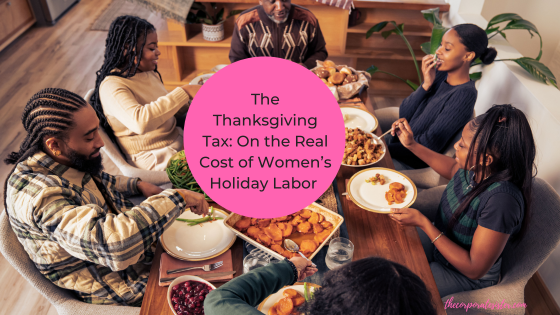
Every Thanksgiving and the ensuing holiday season, many, if not most, women step into an all-too familiar rhythm. It’s the rhythm of tireless planning, strategic coordinating, devoted caretaking, and organizing, smoothing, prepping, cooking, hosting, remembering, and anticipating everything that could possibly go wrong… Yet, somehow, despite all this extensive, yet invisible labor, the holiday narrative is still that the turkey “just cooks itself,” the décor “magically appears,” and family harmony “just happens.”
We trivialize it. We simplify it.
We even laugh about it.
We keep it moving,
As Thanksgiving opens the holiday season of invisible labor for women, one truth remains: While women’s labor makes so much of life possible, so little of it gets accounted for and much of it remains invisible.
The thing is, labor invisibility during the holidays doesn’t disappear when the leftovers do. It follows women right back into the workplace, into their paychecks, their opportunities, and ultimately, into their long-term financial wellbeing.
And this Thanksgiving, we’re putting a name on it. Or rather, we’re renaming it the Thanksgiving tax. And it’s a pretty thankless one at that…
The Thanksgiving Tax: High Labor, Low Reward
Every year, women absorb the Thanksgiving Tax, aka the cost of being the one who “just handles it.”
But this tax doesn’t limit itself to the dinner table. As women and moms, it also follows us in the office as we become:
The default coordinator.
The emotional buffer.
The team anchor.
The behind-the-scenes fixer.
The unofficial DEI counselor.
The mentor.
The stabilizer.
This is all high-output, low-return labor. But most importantly, it’s expensive labor, whose often extravagant cost chokes out the precious time and energy women can invest in work that actually builds income, visibility, and wealth.
Studies reveal women are disproportionately assigned and/or volunteer for non-promotable, low-visibility work, which reduces the time they can devote to high-impact projects that drive advancement. Research and large-scale corporate studies indicate that this imbalance is a key driver of gender gaps in promotion and leadership representation.
For women who are used to keeping everything together, it then becomes harder to step into spaces that elevate their earning potential.
Invisible Labor Creates a Wealth Gap Pipeline
Thanksgiving labor is often invisible. So is so much of women’s work at the office.
As invisible labor leads to fewer raises, slower promotions, and lesser leadership opportunities, these also later translate into lost retirement contributions and reduced Social Security benefits. Research shows when women take on intensive unpaid caregiving and household responsibilities, their labor force participation often falls and their cumulative earnings over their lifetimes decline.
In other words, invisible labor today becomes a visible wealth gap tomorrow.
When women are overloaded with tasks that don’t build leverage, their long-term financial futures suffer. Not because they lack the capacity, but because the systems around them minimize the value of and return on their contributions.
So just as we reflect on gratitude this week, we also have an invitation to reflect on value — the value of our time, our labor, and our expertise. It’s a reflection that prompts us to ask questions such as:
Where is my labor going? What is it costing me? What do I need it to return?
While answers to these questions are different from woman to woman, this process will help us redirect our time and energy toward work that:
increases leverage
builds wealth
expands opportunity
creates visibility
strengthens independence, and
aligns with purpose.
As we come up with our own answers to these questions, here are a few things we can begin to do to reclaim our labor’s value:
Say no to tasks that drain us without advancing us.
Say yes to projects that build capital, whether financial, professional, or relational.
Track our contributions like assets.
Charge for our expertise, be it emotionally, financially, or professionally.
Reallocate energy toward long-term gain, not short-term appeasement.
Women build sustainable careers by treating their labor as the valuable resource it is — and by refusing to let systems discount it.
A Thanksgiving Reckoning…
This week isn’t just about gratitude. It’s also about reckoning with the cost of our labor, the value of our contribution, and the kind of career sustainability that we deserve.
Because in a world where women continue to work harder while receiving less leverage, less compensation, and less recognition, our labor carries a price tag.
So this Thanksgiving, we’re honoring our labor, but also its price.
And as we move toward a new year, may we reclaim our leverage, our value, and our financial future with the clarity and courage that we have carried through every era of change.
How are you honoring the real value of your labor this Thanksgiving season?
Career pauses are often framed as individual, deliberate decisions. For mothers, these pauses, whether due to childbirth, caregiving, or forced because of exorbitant childcare costs, tend to be seen as simply “opting out” when work and family’s demands collide. But the real question is: “Are mothers “opting out” of a system engineered without mothers in mind, or are they being pushed out by the sheer impossibility of thriving in a system that quietly relies on women’s unpaid labor while refusing to support it?” We’d agree on the latter…
Now more than ever, motherhood sits at the crossroads of invisible labor, gendered assumptions, and outdated systemic frameworks. As our work systems were never built to account for caregiving, invisible labor and the related systemic inadequacies, any pause a woman takes is treated as an exception. Yet, it is the inescapable rule for millions of women worldwide.
The reality is: The pause is not the problem.The system forcing the pause is.
Research continues to confirm what mothers already know:
When mothers step back from paid work, the system labels it a decline, or even worse, a loss in productivity. In reality, it is but a labor transfer. Mothers absorb the caregiving required to keep families, communities, and economies functioning. The economy depends on this brave, invisible and unpaid labor. It simply refuses to assign the proper value to it.
Despite this, mothers are still required to be show up fully at work and fully at home. To do it all, and hope to have it all. This impossible dual mandate is what drives burnout, exhaustion, financial losses, and the quietly loud grief of women who feel compelled to choose between their livelihood, their purpose, and their loved ones. Add to it the shame that surrounds career pauses for women, and you get a uniquely manufactured breeding ground for harmful gendered biases and stereotypes of all kinds…
RE-IMAGINING NEW SYSTEMS OF WORK
If we want healthy workplaces that truly work for mothers, we must be willing to re-imagine systems of work that:
– Recognize caregiving as essential economic infrastructure
– Guarantee paid family leave
– Normalize flexible and hybrid work
– Remove bias from performance evaluations
–Treat nonlinear careers as a strength, not a risk
–View career pauses as data, not deficits
Motherhood is not a break in ambition. It is a different form of work—demanding, strategic, and deeply valuable. And it deserves systems worthy of its weight.