This post is part of a Race & Work series on The Corporate Sister blog in honor of Black History Month.
You know the rules, right? “Whatever you do, don’t talk about race or politics at work”!
It doesn’t matter that it may be all over your TV and smartphone screens. Or that we may all be thinking about it as we look at each other in the middle of the meeting room…
YOU.JUST.DON’T.TALK.ABOUT.RACE.AT.WORK.
How do you avoid it entirely then? Well, for starters, you polish your color-blind lenses and put them on. Then you pretend that you can’t see anything remotely connected to race. Even when it’s blatantly in your face. Like when someone makes an insensitive comment about your “unprofessional” natural hair. Or when recent racially charged political events are met with the silence of some of your most trusted colleagues at work.
Race is the big elephant in the meeting room. The one sitting between you and everyone else, that no one really wants to acknowledge. It’s in the unsaid questions, the questioning stares and the politically correct conversations around the conference room table…
How do we talk about the colorful topic of race in the very often bland, colorless landscapes of Cubicle Land? How do we get somewhat comfortable enough to discuss the big R without crossing some invisible forbidden professional line? Or do we just pretend that the whole thing doesn’t exist and sing Kumbaya around the water cooler?
This is the thing though, there are no real practical “tips” to deal with race at work. This is not like “Interviewing 101” or “Office Politics 302”. It’s more complex than that. We’re talking about people ‘s experiences, life stories and most deeply ingrained sense of identity. Not your favorite Starbucks latte with whipped cream on top…
But if we were to set some general guideposts, you know, like those orange traffic cones that tell you where not to step in with your pretty stilettos if you want to keep your legs (and your stilettos), it would go something like this:
Please take your colorblind lenses off!
Ok, it may sound good to say: “ I don’t see color, it doesn’t matter to me if you’re black, white, purple or orange!” Except it’s not exactly the reality… If I turned from my deep shade of mahogany to a sweet peony pink overnight, you’d notice…
We all notice differences in the way we look, because we have eyes and that’s what people do! Distinguishing between my deep mahogany shade and the whipped cream on top of my Caramel Machiatto doesn’t make you a racist, it makes you as discerning as my 4-year old. And the kid can discern just about everything…
What complicates the whole race matter at work, is when anyone makes assumptions about someone else’s intellectual, physical, or emotional state because of their race. And if anything, pushing the colorblind ideology just tells the whole world we’re not comfortable with cultural differences… Which brings me to my point, please take off the colorblind lenses, and look at race in the face…
Racial Stereotypes Do Affect Your Career (Yes, Even the Good Ones!)
For one, racial stereotypes do exist. Secondly, they do affect your career, whether you want to acknowledge it or not, simply because they alter how you’re perceived at work…Now that’s just the reality…That doesn’t mean your work and sheer professionalism don’t count, but appearances are still appearances, and are very often outside of our control.
Even “good” stereotypes, like being a hard worker because you happen to be Asian-American, can affect the type of work and exposure you’re afford in the workplace. As a professional, you need to be aware of these stereotypes, and how they can affect you in the long run. Which also means you need to know your own strengths and weaknesses so you can position yourself better for the opportunities you deserve…
Before confrontation, think conversation first…
If someone’s discriminating against you on the basis of race, the first thing you may want to do is run to Human Resources to defend your rights…Except taking any race-related matter to HR will cause a backlash that may affect you negatively, whether it’s in the form of retaliation or even firing…
This is not to deter you from using the HR resources at your disposal to address race-related matters. But if we’re practical here, you may want to consider starting with a conversation first. Even if it’s challenging, discuss your concerns directly with the person discriminating against you. If the conversation doesn’t help, talk to their boss.
If all else fails, you can certainly take it to HR. However, consider taking more of a constructive, proactive stance by suggesting ways of lessening the damage, rather than insisting to have disciplinary action taken. As in asking for a rotation or transfer for instance…
Get Real About Diversity Training
What about diversity training, you may ask? Isn’t the whole point of sitting yet through another one of those trainings to diminish the effect of bias in companies, aka make Cubicle World a better, all-race-inclusive place? Yes, indeed.
Except diversity trainings seldom succeed in creating bias-free companies. They’re like diversity band-aids, they don’t really solve the problem but do a nice job at protecting companies from getting infected with potentially damaging lawsuits.
So while you should still take your required diversity training, please get realistic about what it can and cannot do…
Welcome to our weekly career, entrepreneurship, lifestyle and fashion news roundup! Think of it as your online watercooler/work gossip station/coffee break spot for now…Want to add anything to our list? Email us at corporate@thecorporatesister.com!
Happy Black History Month! Ellevate Network shares with us a few inspirational quotes from women of color;
News Alert! Beyonce just broke the Internet with the news of her (double) pregnancy. Essence shares with us the scoop!
Performance review time is in full swing! Workology lists 4 reasons to replace performance reviews with frequent feedback;
Recruiter gives you some pointers on how to explain why you left a toxic work environment;
Don’t agree with your boss’s advice? The Muse advises you on how to respond;
Got a job, a side hustle, and a workout routine? Ellevate Network tips you off on making it work without losing your marbles;
Our Wear to Work feature presents workwear for business and professional women in a range of styles and prices. Please note this post contains affiliate links.
There’s something about a smart sheath dress that just makes the day a lil’ brighter…And if you add to it an elegant colorblock pattern trimmed with retro-chic grosgrain ribbon, and a hint of goldstone hardware, you may just be going from desk to dinner in a happy cinch…
Loving the “classic with a twist” look of this dress that can easily stand on its own, worn with minimal jewelry and simple shoes. It’s $315 at Nordstrom.
Very often, we think that what we must do in order to succeed in our careers boils down to one single, powerful and highly celebrated word: Work! Work hard, work overtime, work until you no longer need to be introduced. Work yourself to the bone, work, work, work! And that’s exactly what we do, setting out to “pay our dues” (or hefty student loans), struggle, work late nights, early mornings, through lunch and through the most fun parts of our lives…
Which is all good, until we hit a wall and the hard work no longer pays off. When a switch seems to have gone off, and we’re not quite sure which switch it is, and how to turn it back on, or even if we should for that matter…Or in simpler terms, when we’re “stuck”…
That’s how I, like so many other women in my generation, generations before and surely future generations, come to feel at some point or another in our lives and careers: “stuck”. It’s that “stuck” switch that comes on, apparently all on its own, in the middle of our careers and lives, and leaves us wondering what to do next.
My girlfriends and I talk every day on Whatsapp, and the same word very often comes into our conversations: “Stuck”. We’ve known each other since high school, and are all in our thirties now. While we’ve taken different career paths and are spread all across the globe (from Paris to Senegal, through Italy and Colombia), the resounding message from all of us is pretty much the same: “We feel stuck”!
There are many reasons why we can feel “stuck’ in our careers, from lack of balance to negative office politics, to our own personal choices. Yet whatever the situation we may be in, it almost always requires some sort of a mindset change to get through to the other side of the “stuck” switch, whatever that may be.
For some, the “other side” is simply a new attitude or perspective. For others, it may be a new job, an entirely new career, or some time off seeking their own truths somewhere between Bali and the Himalayas. But in the “in-between” time, we must recognize and learn how to manage that mindset change.
It’s very rare in our college curriculums, or corporate trainings to have the topic of “mindset” discussed or even referred to. Most often, we’re way too focused on work, results, and deliverables. Or on who’s doing what, how office politics affect us and why the glass ceiling is not breaking, falling apart or disintegrating any faster…Besides, who has time for mindset and other woo-woo concepts when there’s already so much work to do?
The problem is, work, as dedicated, devoted and even perfect as it may be, is not always enough. Actually, it rarely is. I mean, how many times have you seen talented, extremely hard-working people put in countless hours in the office, only to reap very limited rewards, if any? And how many more times have you witnessed less hard-working (and frankly less talented people, no shade intended) make it to the top of their fields? Not to mention the crazy number of women stuck in between, struggling to make their careers’ ends meet, only to make two steps forward and five back every other day…
There are a number of qualitative factors that come into play in our careers, and that cannot necessarily be translated into quantifiable terms like the amount of hours worked, the results produced, or any other kind of productivity metrics. It’s the intangible stuff that fills up the empty corners of our careers, those that work alone cannot fill. Things like relationships, politics, exposure, and other less palpable factors we don’t always realize the importance of as we navigate throughout our careers, especially as women. Yet the most important of it all, as I’ve come to realize at my own expense, is your mindset.
The same mindset that allows us to see our worth independently from the actual amount of work we’re able to produce (or coffee we can gulp down). And not to have that worth attached to a position, a string of accomplishments, or to a specific career path.
So many of us women at work believe we’re only valuable because we have a great job, because we’re recognized at work, or because we finally snatched that promotion. Conversely, even more of us are paralyzed, not just at work but also in our lives, by the fact that we’re not recognized at work, are unable to grow through the corporate ranks, or can’t seem to score that promotion or raise.
Most importantly, it’s a mindset that allows us to believe in developing our own talents and abilities, as opposed to constantly striving to appear smart and competent, whatever the amount of sacrificial work and attitude it may take. This is the “growth” mindset that Stanford University researcher Carol Dweck describes in her hit book, “Mindset: The New Psychology of Success“, and contrasts with what she calls the “fixed mindset”:
“In a fixed mindset, students believe their basic abilities, their intelligence, their talents, are just fixed traits. They have a certain amount and that’s that, and then their goal becomes to look smart all the time and never look dumb. In a growth mindset students understand that their talents and abilities can be developed through effort, good teaching and persistence. They don’t necessarily think everyone’s the same or anyone can be Einstein, but they believe everyone can get smarter if they work at it.”
Basically, Dweck’s research has proven that your success really depends on whether you believe your abilities can be developed, or are fixed and already pre-determined. And really, how many of us women bet on what we believe to be our limited abilities while men bet on their potential instead?
How many times do we see women refrain from applying to a given position because they don’t believe they have all the required qualifications, while a man with the same credentials will go fo it, betting on his potential to learn along the way instead?
I love that one of the most treasured career values over at leading airline company Southwest, is known as “the warrior spirit”. In a November 2013 interview published in Forbes magazine, Ms. Hardage, the airline’s Chief Communications Officer at the time, describes it as “being fearless”. What a powerful concept!
Imagine walking into work with that pep in your step, that renewed energy and determination, that “warrior spirit”…instead of the frequent sense of overwhelm and busyness that haunt so many of us, if not most, every time we think about work. And what if it were as easy as… changing our minds?
The biggest lesson I’ve learnt, mostly from my failures and setbacks, is that career success is first and foremost a mindset. One that some may acquire from their upbringing, or prior experience maybe. One that others may struggle with at first, not having been exposed to it or taught about it. But what I also learnt is that career success is not a mindset reserved to a select few, as I initially believed…Like the Mikes of this world…
Let me tell you about Mike, whom I met when I first started in Big Corporate and remained in my career memories for a long while after…
Mike did not need to network; he was the network. The second Mike would step in the meeting room, he’d manage to get to know everyone, from the staff auditor to the partner on the job. By the time he left the meeting, he’d know what everyone was working on, and be recommended on most of the high-profile audits for the year. Mike was the epitome of Big Corporate savvy.
He knew how and when to speak up, could approach a partner as easily as he’d befriend the staff on the team, and could network his way into a promotion, strategic move or stellar recommendation like nobody’s business. In other words, Mike was the opposite of me back then.
As an introvert starting out in Big Corporate, the extent of my corporate battleground was the furthest left corner of my desk. I was perfectly fine tucked in to my own little corner, doing my job, handing in my assignments, and moving right along… Although I was ambitious, I just didn’t know then that I needed more than the resolve to work hard, or a new job whenever things would not work out my way.
What I needed was a new career mindset, one that I could get from stretching and developing my current mindset, however challenging that may be.
AT THE ENDof the day, mindset is a muscle. One that you can develop, and even change, in the course of your career and life. Your success at work doesn’t depend on what others do, or whatever circumstances pop in your life, or however you may think you may be, but rather on the “growth” perspective and mindset you adopt through it all.
Want to read more? Get my e-book “Girl, Take Back Your Career: 7 Steps to Reclaim Your Power at Work“, available on Amazon!
After weeks of anticipation and Internet-scouring, I finally left the kids with their dad, fixed my ‘fro, and went on a girl-movie-date with my sis-in-law to see “Hidden Figures“. I have to say, I was both excited and a bit apprehensive. There comes a point when, as a Black or minority person, you get slightly weary of watching anything reminiscent of your community’s suffering and challenges. Yet, at the same time, you have this yearning at the pit of your stomach to honor the stories of those who went before you and make them part of your own…
And Hidden Figures doesn’t just succeed at making the stories of three pioneering African-American whose work for NASA contributed in several historic space missions part of my own. It also accomplished the amazing feat of successfully telling many of our own untold stories…
The movie recounts the stories of Katherine G. Johnson, Dorothy Vaughan, and Mary Jackson, who in the 1950s, literally calculated by hand the launch of astronaut John Glenn’s trajectory into space. Based on the book of the same name by author Margot Lee Shetterly, it tells of extraordinary willpower by amazing women in the midst of a gut-wrenching struggle.
As a result of Virginia’s strict segregation laws at the time, African-American women computers worked in their own “colored” building in the reputable Langley Center. At the time, the U.S. was desperate to beat the Soviet Union in the “race to space”. It’s in this highly heated context that Katherine Johnson (Taraji P. Henson), a mathematics genius in her own right, gets assigned to the illustrious task group in charge of sending the first American man to space. As the sole Black woman in the room, she faces blatant discrimination, even as she produces work of outstanding quality.
On the other hand, Mary Jackson, played by Janelle Monae, is one feisty sister battling racist bureaucratic hurdles to become the first NASA woman engineer. Dorothy, played by the fabulous Octavia Butler, is a dedicated, generous to a fault, group leader fighting for an overdue promotion, while facing the risk of her entire team being replaced by a new IBM machine. Against all odds, Dorothy teaches herself the art of programming, and becomes NASA’s first African-American manager.
There were many moments in the movie that grabbed me by the throat, threatening to make me break into the “ugly cry” all over my over-buttered popcorn. But it’s three of these moments that hugged my Black working woman’s conscience tighter than spandex leggings on a diet cheat day:
That moment when Katherine finally discloses to her boss (played by an ever-charming Kevin Costner) that her long, daily absences are due to her having to run over 4o minutes across the Langley Center to the only “colored” bathroom, and stands up for herself by denouncing the blatant racism around her, including the dingy coffee pitcher with a “colored” label on it reserved for her;
That time when Mary goes to court to request the right to attend night classes at the local segregated school to become an engineer, arguing to the judge that just like he had been the “first” in his family to become a judge, she was looking to become the “first” NASA woman engineer too ;
Finally, that moment when Dorothy expresses her ambivalent feelings about Katherine’s successful assignment to the task group, outlining that despite the fact that “upward movement for one of us is movement for all of us”, discrimination still remains the norm for many others.
Hidden Figures tells the story of real women who are not just brilliant, but also extremely generous with their intelligence, their time, and their patience, to serve a common, patriotic goal. It tells the story of women like you and I, fighting to get ahead against the established status quo. Women who give much, sometimes too much, even when there’s not much left of themselves to give away. Women who stand up for themselves and their sisters, even when it means putting themselves and their careers on the line. Women who watch these sisters rise up, and celebrate while wondering when their turn will be.
I was weary of watching yet another movie rooted in racism and discrimination, but was glad that Hidden Figures turned out to be a heart-soothing, light, and even hopeful affair. While I have as much of a clue about aeronautical formulas as I do about neurosurgery, the film was rooted in such a human spirit of connection that it didn’t matter. What it wasn’t trying to do was romanticize the concept of racism and pretend that it’s been solved. Instead, it was a realistic take on a tough subject matter that needs to be talked about more…
All in all, Hidden Figures lends a powerful lens into what it means to be a talented woman shut out of opportunities on the basis of the color of your skin. But it also sheds an all-too-important light on the impact of sisterhood, community, and the sheer power of having the audacity to believe more for yourself…
Enjoy the trailer below:
What did you think of the movie? Please share your insights in the comments below…
Welcome to our weekly career, entrepreneurship, lifestyle and fashion news roundup! Think of it as your online watercooler/work gossip station/coffee break spot for now…Want to add anything to our list? Email us at corporate@thecorporatesister.com!
In MAJOR news this week, BBC News reports Serena Williams beats her sister Venus in the 2017 Australian Open to make history ! #blackgirlmagic
It’s the week-end! Well, Business Insider urges you to stay away from these 11 things that unsuccessful people do on week-end;
No degree, no problem? Glassdoor lists 14+ companies that no longer require degrees (and Google is one of them);
Workology shares what’s new in diversity hiring in 2017;
The Muse shares 5 simple ways of saving money this year;
Speaking of money, tax money more specifically, The Corporate Sister tips you off on different types of work expenses you can deduct from your tax return this year;
Already burning out at work and it’s only the first month of the year? Read on these three ways to overcome it from Ellevate;
Superbowl is right around the corner! Acouplecooks shares healthy Super Bowl recipes that will wow your friends;
PopSugar shares this amazing line of cosmetics offering an inclusive range of complexion and color cosmetics for women of color.
Anything you’d like me to add to the list? Email me at corporate@thecorporatesister.com!
Our Wear to Work feature presents workwear for business and professional women in a range of styles and prices. Please note this post contains affiliate links.
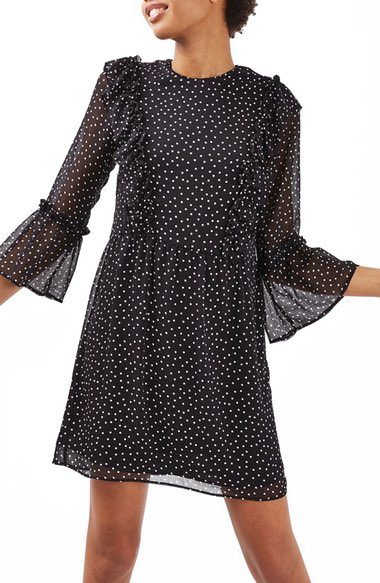
Nothing says fun workwear quite like this Toyshop spot ruffle flute dress. Loving the playful energy of the flowy fluted sleeves and girly ruffles. It’s perfect to take from desk to dinner, under a blazer like this two-button beauty, or this elegant camel coat. This dress is $90 at Nordstrom.
In the same style, I also like this Valentino short-sleeve ruffle front A-line dress from Neiman Marcus.
Seen any piece you’d like to recommend? Email me at corporate@thecorporatesister.com!


 This post is part of a Race & Work series on The Corporate Sister blog in honor of Black History Month.
 Welcome to our weekly career, entrepreneurship, lifestyle and fashion news roundup! Think of it as your online watercooler/work gossip station/coffee break spot for now…Want to add anything to our list? Email us at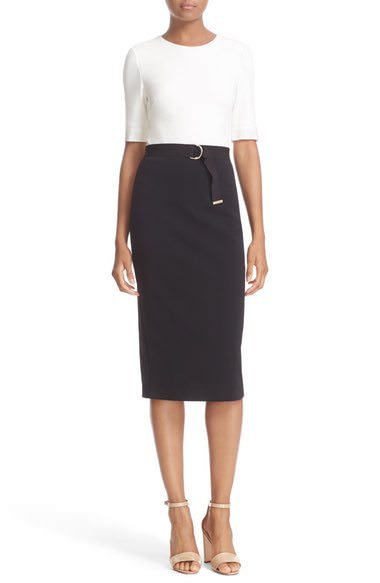
 This post is an excerpt from my e-book “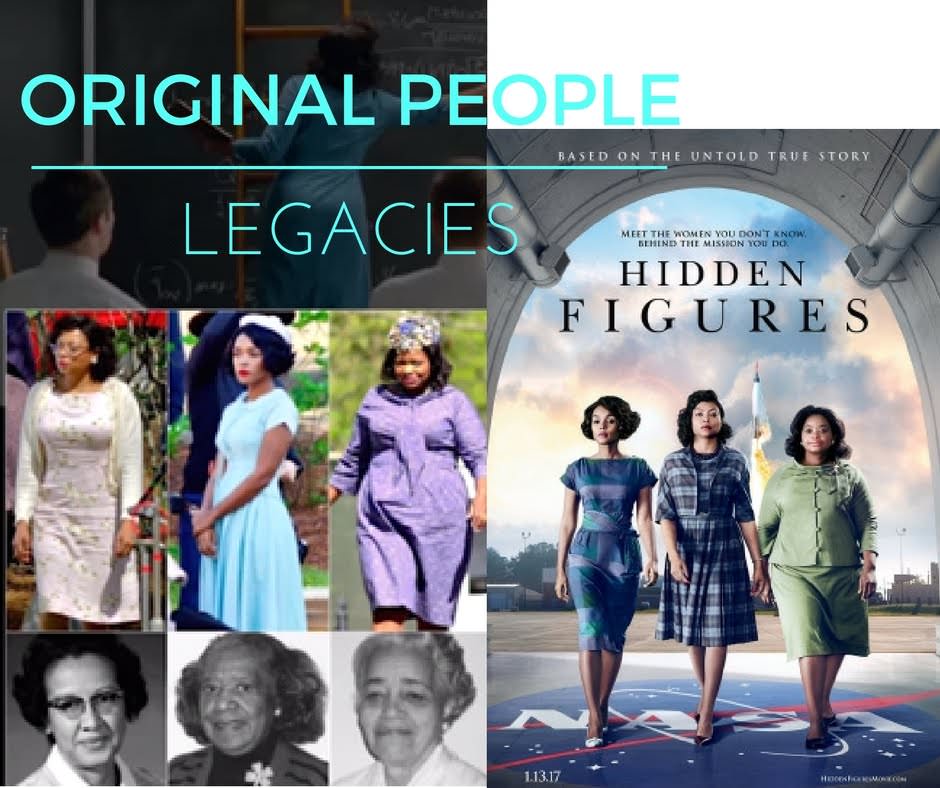
 After weeks of anticipation and Internet-scouring, I finally left the kids with their dad, fixed my ‘fro, and went on a girl-movie-date with my sis-in-law to see “