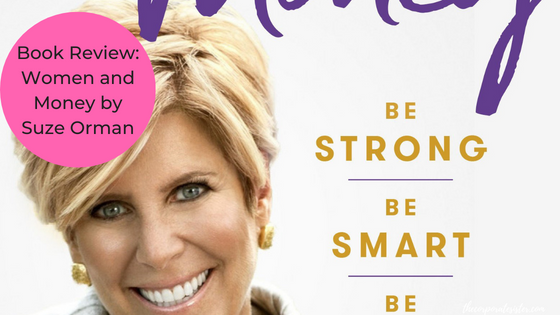
If you’ve ever thought of taking control of your finances as a working woman and mom, Suze Orman’s “Women and Money” book is a must-read. This revised and improved edition from her 2007 original masterpiece certainly does not disappoint when it comes to establishing, or re-establishing for that matter, a healthy relationship with your money. I know it certainly helped me…
I’ve had the earlier version of this book on my shelf for many years, and have only recently decided to dig into it, especially when starting the new year. As my word for the year is “consistency”, I resolved to apply more consistency to all the areas of my life, including my finances. When I noted this “oldie but goodie” book had been recently revised and edited, I couldn’t help but order it. What I discovered as I perused its pages in just a few days was nothing short of a financial eye opener…
As a working woman and mom, with training in accounting at that, I’ve always known, in theory, how important it is to have a good handle on your money. As much as I could, I practiced applying sensible rules to managing my money, from budgeting to saving and even dabbling intoinvesting. What I didn’t do as much of, is to take some time to pause and reflect on my relationship, past, present and future, with money. And this is exactly what this book made me do…
In the book, Suze, who in my head I picture as my financial big sis, first starts by discussing how we have been relating to money as women since the dawn of times. She accurately points to the fact that so many of us, even as educated and professionally successful as we may be, seem to experience an inner resistance to dealing with our own money. This ties back to the fact that for the longest time, women have been conditioned to defer money matters to the male figures around them, from parental figures to spouses. As a result, there has been a dissociation between women’s mindsets and money.
Reading this, and even though I was raised by a single mom, I could identify with this inner resistance, this sense that even as an educated, ambitious woman, I tend to experience a lack of closeness to and clarity about my money. The more I turned the pages of this book, the more I could relate my own experience with money to the fear that many, if not most of us, experience when it comes to being free and decisive about our personal and financial futures. Instead, we often end up treating our money as we treat ourselves, with the same fear to displease others, the same fear to not belong or fit in, or that to be rejected…It’s also the same fear that prompts us to not ask for a raise at work, sell our services for less than they’re worth, and allow our significant others to mismanage and abuse our own money… It’s the same fear that basically, as Suze puts it, prompts us to put “ourselves for sale”…
Confirming that, like so many women, I need to take a good look at my relationship with money, opened my eyes, especially as a woman in my 40’s. What this book also allowed me to realize is how important it is to use time and knowledge to our advantage to build a secure financial, and ultimately, personal future. Tips such as living below our means in order to boost our retirement savings, investing in life insurance, preparing to support kids in college through 529 plans, and setting up key documents such as wills and revocable trusts, are a much-needed wake-up call for all women and mothers. The importance of planning our financial futures early, not only for ourselves, but most importantly for our loved ones, is often ignored at the expense of pleasing others and surviving. What we often do not realize is that not taking care of our financial health does not only impact us, but our families and communities in the long run.
Overall, this is a book I highly recommend and consider a must-read for all women. More than financial tips, it urges us to revisit our relationship with ourselves and money, and set ourselves and loved ones for success. If anything, taking care of our money is a gift to ourselves and others around us.
Motherhood is beautiful. Yet, for many working mothers, especially in the US, especially in the past few years peppered with global pandemics, political and economic woes, motherhood has been “hard”. Hard is not often a word that we want to associate with being a mother, at least not one we dare to speak out loud when it comes to mothering. Yet, it certainly is the reality for many, one we soften with cute Instagram videos and funny stories, but a reality nevertheless. As many women after the COVID pandemic especially are turning to a “softer” approach to life and work, they’re also turning to a “softer” kind of motherhood. One that seeks to relieve the pressures of modern motherhood, allowing women to mother more lightly, more happily, more authentically…
I remember having a conversation with a fellow mom at my kids’ school. She laughingly was recounting how one of her daughters had told her on the ride to school one morning, that she did not want to be a mother when she’d grow up. When asked why, the young girl responded: “ Because it is so hard…” That made me think about all the times my own children may have thought the same thing. All the times our kids, nieces, or nephews look at us , between drop-offs, pick-ups, after-school activities and overflowing laundry baskets, and vow not to have children of their own, because…it looks so hard. And this is considering that most of us make it look easier than it actually is…
Many women are hitting walls of exhaustion and burnout, and bravely acknowledging it, as New Zealand’s ex-prime minister Jacinda Ardern did by stepping down earlier this year. As they do so, they are also sending the signal that things cannot keep going as they have been. Even as the world needs increased gender equity, diversity and inclusion, what it doesn’t need are mothers too exhausted to fulfill their potential in and outside of the home. Yet, with companies reneging on work-life balance measures and slowing down their diversity efforts, this is also signaling an urgent need to step back, stop glorifying the “hard” path to working motherhood, and instead re-imagining a softer way.
Often, when we hear of taking a “softer” approach, we may be tempted to think the latter would be less effective. In a society focused on over-performance at the expense of effectiveness, we’ve unfortunately come to equate “hard” with “effective”, or even “worthy”. Yet, the opposite couldn’t be truer. When it comes to motherhood, “hard” erodes the foundation of healthy mothering. Hard motherhood is motherhood that lacks flexibility, motherhood that barely survives rather than thrives, motherhood that is not full or complete, but only a shadow of its true potential. When mothers are submitted to unbearable pressure to perform, produce and deliver in the midst of a blatant lack of social, economic and political support, they are not set up for purpose, fulfillment or success. On the very contrary, they are set up for failure. And when mothers are set up for failure, families, communities and entire societies are set up for failure.
So what are we to do when ditching hard motherhood for softer mothering? In our modern society focused on productivity and results, it’s a tall order. Yet, it’s a change that can occur gradually starting with a few underrated, yet oh so effective principles:
Changing our minds about what it means to be a working mother
It all starts with mindset. For many, if not most working moms, motherhood has become an endless performance. From the wee hours of morning, to late night, they’re performing and giving of themselves without so much as a respite. The tiredness, the exhaustion, even the resentment have become a badge of honor, and the source of many acclaimed social media memes. If you’re a working mom, you must be tired. If you’re a working mom, you must not have time for self-care. If you’re a working mom, you must deny yourself, day in and day out. I remember an acquaintance telling me when my kids were still babies, that I did not look like a working mom because I was too well-put together. So does looking disheveled and piling on the under-eye concealers otherwise qualify us to be valid, worthy working mothers? Nope.
This journey towards softer motherhood begins with a changedmindset around what it means to be a working mom. It means redefining working motherhood in terms of better work-life integration, increased fulfillment and purpose. No, we don’t have to look like we’re on the brink of burnout to be approved as good mothers.
Reframe our careers and lives
The next step is to reframe our careers and lives around this mindset of fulfillment, purpose and fullness on our own terms. What are our non-negotiables? How do we take better care of ourselves in order to take better care of others? What can we take off of our plates rather than adding in? Where, and how can we get the support we need? These are a few questions to begin and continue the conversation.
Reframing our careers and lives is a matter of re-envisioning what a sustainable schedule looks like, from work obligations to kids’ activities. It is creating margins and boundaries in otherwise impossible timetables. Sometimes, it may be a matter of getting rid of the entire timetable altogether.
Taking back our power
Last but not least, softer mothering is about taking back our power to live fuller, more authentic lives that do not reflect a fraction of our potential, but as close to its entirety as possible. It’s about reclaiming the time that is so freely given away and under-estimated, and requesting the infrastructures and support needed, whether it’s childcare, flexibility or equity in the home. Finally, it’s about getting rid of the creeping, generational, overwhelming fear that keeps us from prioritizing our needs, and regaining the confidence to be the mothers we were created to be.
At the end of the day, motherhood was not supposed to be hard. Not this kind of societally-imposed, articificially-made “hard”. Is it bound to be challenging? Yes. Is it supposed to be easy? No. But this hard shell of modern motherhood that seems to be offered on the platter of “having (and doing) it all”, is not it. Rather, re-imagining a softer, effective, and sustainable approach to modern mothering is a better path to creating and sustaining societies that can thrive, and not just survive.
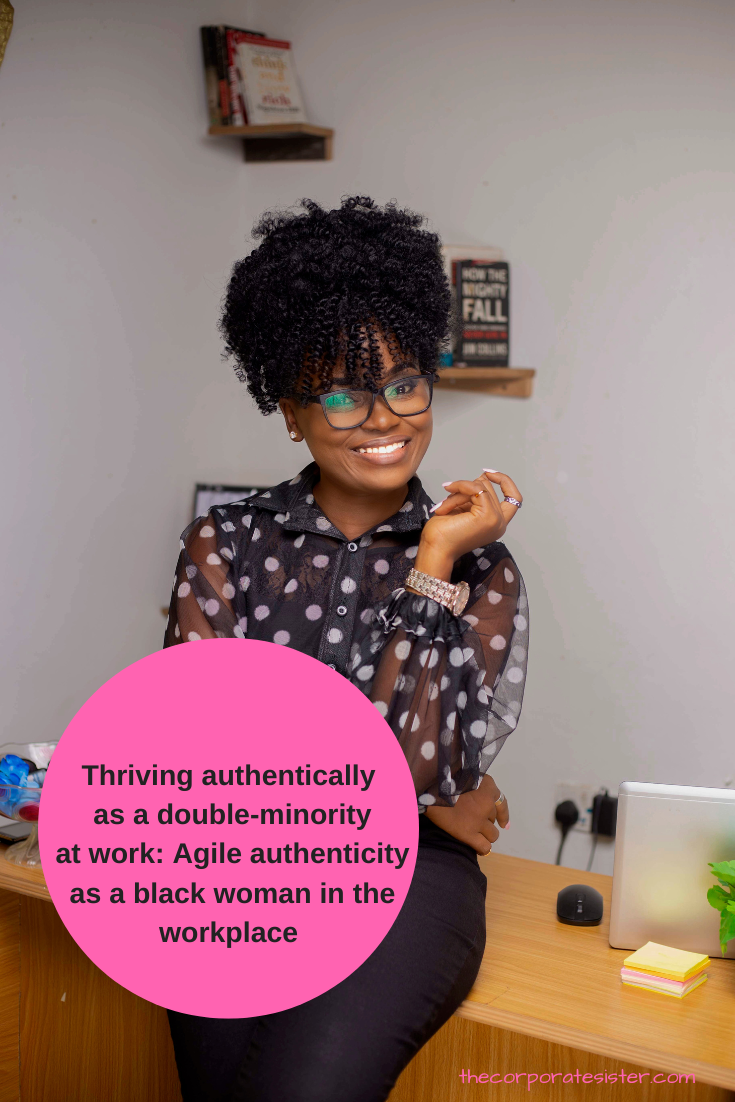
In this episode, the first of Black History Month 2023, I discuss what it takes to thrive, and not just survive, in the workplace as a Black woman at work, and as minorities in general. More specifically, I talk about the concept of “agile authenticity”, which requires awareness, impact and a master plan to succeed in the workplace on one’s own terms while still remaining authentic.
Listen in!
Thanks for Listening!
Thanks so much for tuning in and listening to this week’s episode! If you enjoyed this week’s episode, please share it by using the social media at the bottom of this post!
Also, leave me a review for the TCS podcast on Apple Podcasts !
In her book “ The Light We Carry”, Michelle Obama discusses the many challenges of navigating being a black woman in any type of workplace, many of which she experienced herself in her professional life and as First Lady of the United States. She refers to being a double minority in the workplace as navigating different worlds, their worlds of origin and the professional and/or social worlds they’re entering as minorities. This is something most Black women, and most minorities, can certainly identify with. It is this duality of experiences and being that has given rise to code switching, which as draining as it may be, is also a survival tool for many.
Being a minority in the workplace, at times the only minority or one of a very few, definitely means moving between different worlds. Many come from environments where they may be “the first”. The first to go to college. The first to attain a certain type of career success. The first to think, behave and grow differently. This already creates a chasm in their environments of origin, making them stand out, often alone. As they get into environments where they are “the only” or one of a very few, they also stand out, often alone. What we often don’t realize is that many, if not most minorities in the workplace, stand out in both their worlds of origin and their professional worlds, making it even more challenging for them to show up authentically and overcome the obstacles on their way, from discrimination to blatant inequities. Not only do they stand out in both worlds, but they often also feel a sense of needing to satisfy both worlds through performance, sacrifice, even rebellion…
For many, if not most Black women at work, making it professionally then becomes a matter of sheer survival. Many find themselves barely keeping their heads above water, as they tirelessly work to address the pressures from the inside, i.e. their personal and social environments, and those of the outside, i.e. their professional environments. This often results in an excruciating and toxic push and pull between where they are going in terms of professional, even personal, emotional and all around spiritual growth, and where they’re coming from.
So how does one reconcile this pull between worlds as minorities, more specifically as Black women in the workplace, without losing one’s authenticity? How does one achieve a sense of wholeness when pressures keep building in opposite directions? Most importantly, how does one authentically thrive, instead of barely surviving while standing out and often being isolated? It’s certainly a tall order, a dilemma for the ages that is going to require more than an article to solve. It’s also part of an ongoing conversation for us all to have. As part of this conversation, the concept of “agile authenticity” emerges, which combines the value of authenticity or knowing oneself with that of authentically adapting to the various seasons and environments we’re exposed to. As part of this, three principles arise, which I like to call the “AIM” framework of agile authenticity:
Awareness
When it comes to authentically thriving in the workplace as a Black woman, or any person of color at work, awareness is key! It begins with self-awarenessat the core of it, rooted in a solid and continuous understanding of one’s core values. Asking questions such as: “What are my core values in this season of my life and work?”, goes further than just identifying what is important to us. It digs deeper into our growth and current state as individuals, and also provides more information to build upon.
It also involves being acutely aware of one’s environments. Each environment, whether personal or professional, has its own implicit and not-so-implicit rules, processes and systems. Understanding our environments of origin and those we evolve in professionally is crucial to remaining grounded and agile as people and individuals. This is when we know when and what to share, how to present ourselves, and what boundaries to draw.
Impact
“What is the impact I can and want to have in my environments at this very moment?” This is a question that often eludes as minorities in the workplace, as the focus is often put on performance. Yet, even more than performance, impact is what helps us make a difference. If our performance does not positively impact our communities and those around us, what is the point?
Switching the focus from performance to impact, more specifically timely impact, then radically changes the way we think about work and life. Instead of endlessly measuring productivity on others’ timetables, we can measure the impact we have, whether in terms of cultural change, education, or increased equity.
Building a Master Plan
Last but not least, combining awareness and impact allows to build a master plan to thrive in, and even outside of work as Black women, and minorities in general. Being aware of oneself and one’s environments helps identify areas of strength and improvement, while allowing to assess which environments are best for us, and how best to operate in them. Thinking in terms of impact rather than performance gives an evolved perspective of the work we do and the real change we create. All this ultimately contributes to building an evolved career master plan that can help, rather than hinder, navigating the various environments around us.
All in all, thinking in terms of, and practicing agile authenticity as Black women, and minorities in the workplace, can help one thrive, instead of barely surviving in between different worlds. While it requires an acute sense of awareness and impact, it certainly can contribute in building one’s own master plan of success at work.
In this episode, I chat about planning for work-life integration instead of work-life balance. How about planning to integrate all the areas and aspects of our lives and careers, instead of compartmentalizing and attempting to balance it all! Listen in on this episode!
Thanks for Listening!
Thanks so much for tuning in and listening to this week’s episode! If you enjoyed this week’s episode, please share it by using the social media at the bottom of this post!
Also, leave me a review for the TCS podcast on Apple Podcasts !