Holiday stress is real. For working moms, it’s all too real. So much so that it can rightfully be considered the other silent pandemic for working moms. One that takes a heavy psychological, mental and certainly physical toll on working mothers tasked with the oh so unrealistic and overly taxing job of creating the overrated, overly expensive and unnecessary magic of the modern, over-the-top family holidays…
I remember times when the true magic of the holidays was about spending time together, sharing homemade gifts and laughter around a good, simple meal. Times when receiving ONE gift, just one, in my home country of Senegal, was enough. When a small, poorly lit, scarcely decorated tree was a luxury…There was magic then, real, unadulterated, magic, even in 80-degree weather in a country where Christians were, and still are, the minority…Even then, working moms were also largely in charge of orchestrating the holiday magic, yet it was an organic magic that was already there…
Fast-forward a few decades, and the organic holiday magic has been replaced with the commercial archetype of consumerism, complete with perfect hosting tableware, exquisitely wrapped premium “toys of the year”, and over-the-top everything…All of it to be organized, managed, budgeted and delivered by the industrious, best-dressed, physically fit, and pleasant all-around-wonderful working mothers of the year, at the risk of raising self-entitled children and perpetuating an already existing unfair division of labor in the household…With a smile too, please and thank you…
Yet, it doesn’t have to be this way. In an interview with CNN, Brigid Schulte and Haley Swenson, respective Director and Co-Director of Better Life Lab, a New America think tank’s program with the purpose of advancing gender equity and elevating the value of care, suggested that easing working mothers’ holiday load should be a family affair. According to them, discussing the holidays as a family is a crucial initial step. This allows everyone, Mom included, to share what they truly value about the holidays. This way, everyone is clear on what is important, and there’s room for the mother to also express what she values, so as to get what she also needs out of this precious time of year. The same rationale can also be applied to gift-giving, as a meaningful (and not just commercial) process involving the whole family, and not just one falling on Mom’s shoulders. Likewise, the responsibility of organizing these discussions should also be spread among all family members, so as not to be Mom’s burden.
These insights from the Better Lab are extremely valuable, in that it is high time (and has been for quite some time) to consider this silent pandemic plaguing working moms at a time of year when the proverbial cheer is often replaced with exhaustion, worry and even depression for many. How can you, as a working mom, practically implement the necessary changes in your own household so you can finally enjoy the holidays instead of working through them? Here are a few tips to get started:
Assess what you would want out of the holidays
What would the ideal holidays look like for you? What do you truly want out of this time of year? What traditions are important to you, and what others are not so important?
These are examples of questions to ask yourself and honestly answer as a working woman and mom. This is also an introspective process that will require you to shed society’s pre-conceived notions of working mothers’ role, especially during the holidays, and instead embrace the truth of who you are and what you truly want.
Have an honest conversation with your family and friends
Establishing what you want out of the holidays is only the first step. The second, and often most challenging step, is to communicate it to your loved ones. This can be especially hard an overwhelming sense of “mommy guilt” may seep in and take over. You may also face the shock and even resentment of your family and friends, who may not initially understand your transformation and/or frankly desire to go along.
However, despite these obstacles, having an honest, transparent and forthcoming conversation can go a long way towards beginning (and continuing) to lay the foundation for a different type of dynamic during the holidays. An important part of the conversation will be to consider everyone’s values as related to the holidays, yours included, and reach a compromise around sharing tasks and responsibilities that honors these.
Relinquish control
Last but not least, it’s going to be so important to learn to let go! As a working mom, as much as may want to have different, more balanced holiday traditions, you may face your own need for control stubbornly standing in the way of change. It’s ok to relinquish control, let others take over, and take a backseat, at the risk of things not being as “perfect” and flawless as you would like them to be.
Are you a working mom who’s ready to end this silent pandemic of holiday stress? Email us at corporate@thecorporatesister.com and tell us your stories of change.
The end of the year is a particularly busy time, especially for working women and moms. Not only are most of the holiday-related tasks, including gift-buying and giving, as well as hosting and prepping, on women’s to-do lists, but work responsibilities also tend to pile up then too. With all the distractions and other personal and family obligations over the holidays, staying on track and on task at work can be quite the challenge. As working moms, it becomes a matter of efficient strategizing to boost your career (without losing your sanity).
In my experience, attempting to do it all over the holidays (and frankly at any other time) is close to impossible. Rather, it forces so many of us to over-extend ourselves, push beyond our limits, and threaten our own mental and physical health, not to mention our sense of self and joy during what is supposed to be the most wonderful time of the year.
This is where a solid strategy comes into play, one that does not require piling on more than what is necessary, but rather conducting an honest assessment of where we stand and fill in the gaps where absolutely needed:
Check in with your beginning of the year goals
There’s a famous African proverb that says: “In order to know where you’re going, you must know where you’re coming from.” This applies to all areas of life, but I’ve found it most impactful in the workplace. To close out a year successfully and set out the best direction for the future, it’s important to go back to what was set in motion at the beginning of the year.
What were your beginning-of-year goals? What priorities did you set to achieve when the year started? How did you do with these? This will not only allow you to celebrate what you have been able to achieve and get some much-needed encouragement and motivation. It will also allow you to identify what is missing and may need to get done before the end of the year.
Prioritize impactful pending tasks
As you identify and prioritize remaining tasks that need to be addressed by the end of the year, or have to put out some last-minute holiday fires, take some time to prioritize. Again, not everything needs to be done by December 31! Not everything is a priority.
However, there are some tasks that have more impact on your career and track record, as well as on the short-term welfare of your team, department and/or organization. These are the tasks that should be on your priority list. Anything else that can be postponed, delegated, or even cancelled should go.
Communicate your needs and plans!
As busy as the end of the year may be, it’s also a time when communication with your team and colleagues is of utmost importance. As you set your priorities and to-do’s to attend to, including your personal priorities, it’s crucial to communicate these to those who are also impacted by your work.
Getting on the same page with those you work with will help you avoid many a misunderstanding, and even get you the support, help and encouragement you need to bring your work to a successful close this year.
Say NO
If there is any time when using the power of NO comes in handy, it’s during high-stress, high-expectation times like the holidays. As a working woman and mom, so much is expected of you over this time, from family, friends and colleagues alike. This is the time to know and recognize your own limits, not in an admission of weakness (all to the contrary), but rather in an honest and quite powerful way to preserve yourself and others.
Keeping the lines of communication open and delineating the impact of the tasks on yours and your team’s to-do list, and most importantly being honest and transparent, will save you much trouble and headache. Most importantly, it will allow you to free up time to focus on what truly matters to you.
Recap and learn
One of the most important parts of successfully closing the year at work is being able to learn from the time that has passed. In a haste to get it all done, so many of us miss out on the opportunity to truly learn and grow just by analyzing the patterns of the past year and drawing invaluable insights from these.
What worked well this year? What didn’t work so well? What are impactful areas of growth? What should be kept, and what should be dropped, delegated, or postponed? What can be tweaked or totally changed? These are just some questions to ponder and learn from as we close a professional year.
Set your goals for next year
Last but not least, out of all that’s been done, learnt and worked on during the year, along with our desires and purpose, our future goals should emerge. While they may not be totally clear as we close the year, they should feed off our experience, victories and lessons learning to at least start forming the beginning outline of what we want the future to look like for us.
How do you successfully manage the close the year at work as a working woman and mom?
As much as many of us look forward to the holidays, there’s no denying that they can also be quite the stressful financial time, especially for working moms. As the imbalance in the sharing of household responsibilities persists throughout the pandemic and beyond, working moms tend to bear the glorious, yet exhausting, burden of managing and orchestrating the holidays. This also comes at the cost of much financial stress and instability, especially coming out of the global health crisis created by the pandemic. Considering the heavy impact of the pandemic on working moms, saving money becomes not only important, but necessary…
As a working mom myself, as well as an accountant by trade, managing my financial resources, especially during the holidays, is always important. While there are a number of budgeting and cost-saving tools out there, one of these, that has particularly attracted my attention is Fluz. At a time when demands on your money are so pressing and numerous, this app is reinventing the concept of cash back. Beyond one-off incentives and small rewards, Fluz offers its users the opportunity to leverage each and every purchase by earning money back instantly. This is so good that as you purchase a gift card, you can earn cash back on it even before you use it! In addition, this app also creates countless opportunities to use one’s network to earn even more!
Here is how it works:
Step 1: Pick the stores you want to shop at!
You can pick from a variety of stores including everyday favorites like CVS, Dunkin’ Donuts, and Domino’s, or family favorites like Nike, Baby Gap, or food and entertainment spots like 99 Restaurants or Applebee’s. Or you can also use the Fluz app to earn cash back on some of your more seasonal needs from stores such as 1-800-Flowers, or 1-800-Baskets. There is literally a store for all your needs that you can shop at using the Fluz app!
Step 2: Pay with your Fluz app.
Once you pick the store of your choice, then you can whip open your Fluz app, select said store, and enter your checkout amount so you can pay and get a gift card code in exchange.
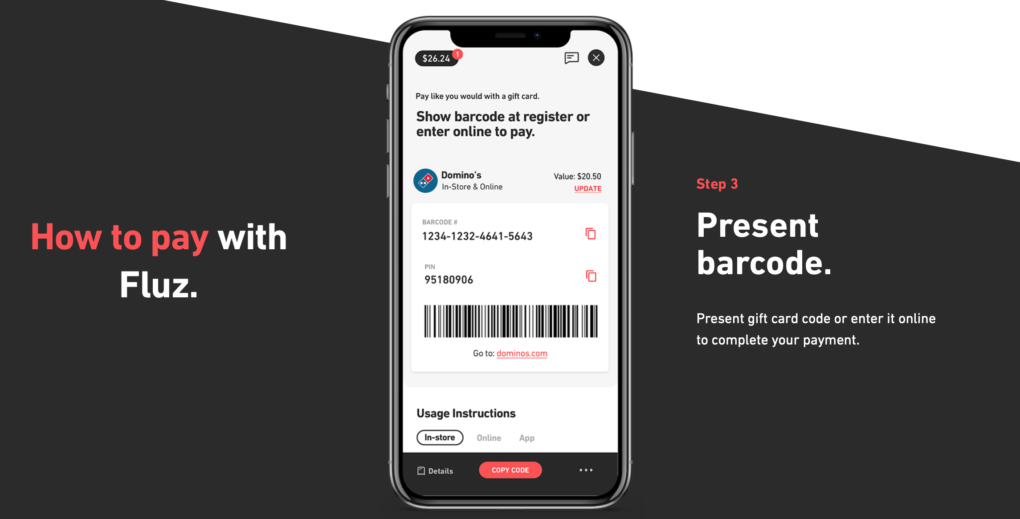
Step 3: Present your barcode.
All you have to do then is present the code to the store cashier or paste it during the online checkout process! Easy enough?
Step 4: Instantly earn your cash back!
As you make your purchases as described above, you instantly earn cash back. No need to wait to actually redeem your gift card! You earn money back right when you pay and obtain your gift card code…
The best part? This doesn’t just stop with you. The more the merrier, actually…You can invite your network of friends, family, associates, and colleagues to join in the fun (and savings) simply by sharing your referral code online.
Let’s begin right here, as I invite you to join in the fun by using my referral code: THECORPORATESISTER12
Log in to the Fluz app here, enter my referral code and start earning cash back. And you can do the same by inviting your network to join in as well!
Being a working mom is hard. Being a working mom during and in the slow aftermath of a global health crisis and pandemic is beyond hard. Things were already challenging before the pandemic, from working in and outside of the home, wearing too many hats to remember, and dealing with pressure both at work and at home. After over 18 months of remote working and homeschooling children, managing the home and career front, and struggling to keep their sanity intact in the face of school and daycare closings along with a pressing lack of childcare, working mothers are tapped out. About two million women have left the workforce entirely already as a result of the pandemic.
However, most working moms do not recognize or acknowledge burnout until it reaches a critical point. Yet, it is a valid and recognized health condition, which has actually been added as a syndrome to the International Classification of Diseases by the World Health Organization (WHO). The WHO defines it as “chronic workplace stress that has not been successfully managed”. Dr. Sheryl Ziegler, author of “Mommy Burnout”, adds: “The pandemic has revealed how closely tied mental health and stress are and I think a lot of people have hit their breaking point and they just can’t get by anymore.”, on a CNBC interview.
Burnout manifests itself as a host of signs, including:
Feelings of exhaustion
Feeling unproductive
Depersonalization (feeling cynical, disconnected and unmotivated)
Insufficient or poor self-care
Poor sleep
Concentration problems
Mood instability
Feeling isolated
Physical symptoms such as headaches, chest tightness, and stomachaches
If you recognize any of these signs in yourself or someone you know, here are a few tips to cope:
Acknowledge the problem
Be honest with yourself and others. When burnout occurs, the temptation may be to isolate and disconnect from others. Instead, consider reaching out to friends, family and using therapy as a way to cope.
Seek help
Burnout is a clear indication that you need help. Whether it’s asking your partner to pitch in more with household chores and parenting responsibilities, hiring a housekeeper, or requesting a more flexible schedule at work, tap into your network to get some help.
Set boundaries
Learn the art of saying no, or at least taking the time to consider requests coming your way. You don’t have to do it all or say yes to every demand on your time, space or energy.
Create some boundaries between your various tasks, as well as between your personal and professional spheres.
Schedule some time for yourself
This may be easier said than done, but it’s absolutely crucial to set some time for yourself to tend to your own self-care. Whether it’s waking up a bit earlier to read and journal, or saving some time for yourself in the middle or at the end of the day, carving some time out of your busy schedule can help relieve a lot of stress.
Create a routine
A lot of stress is created by blurring the lines between work and life, as well as parenting and other areas of our lives. Instead, consider setting up a flexible, predictable routine that separates your work and personal lives.
Stop multitasking
Research has extensively proven that multitasking is not effective, and can actually be counter-productive. Instead, consider switching your approach to focus on one task at a time.
Lower the bar on expectations
Last but not least, consider lowering the bar on your high personal and professional expectations. Instead, focus on building simpler habits such as meditating and getting adequate rest.
How have you been coping with burnout as a working mom?
For most working women and moms, having a flexible schedule is a blessing. It can also quickly turn into a curse if, and when, not managed well. Trying to fit in everything that could possibly fit into your schedule, or on the other hand, underestimating what needs to be done and wasting precious time, can both wreak havoc on your time, energy and self-esteem. As a result, flexibility can be a trap for so many working women and moms, who can end up overworked, frustrated and exhausted from it.
As much emphasis is being put on affording working mothers a more flexible schedule, what is not talked about as much is what it can cost the latter. On one hand, due to subjective work and gender-related negative perceptions about remote work and flexible schedules, the lessened face-to-face time has been shown to hurt working women’s advancement and promotion prospects in the workplace. On the other hand, while a more flexible schedule allows working moms the latitude to handle their various responsibilities, it also requires them to carefully plan ahead and manage their newfound flexibility. The latter is a significant challenge for many working moms who often feel a need to overcompensate for it, and don’t always have the tools to efficiently use it.
Managing the blessed trap of flexibility is an exercise in discipline, focus, but also self-awareness. Here are three tips that can help:
Set “sacred” areas for work, life and relationships
Flexibility can give us the impression that we have all the time in the world to get everything done. This is when the various areas, priorities and demands of our life and work can get mixed up in a feverish mishmash of to-do’s. As a result, while we may end up genuinely doing a lot, we may also miss out on the most important tasks and priorities, and work ourselves right past what truly matters, both personally and professionally.
This is why it is so important to set “sacred” areas and times for work, life and relationships. Professionally, it may be a matter of defining what our most important work is, and dedicate the best and most time to it. Personally, it’s a matter of also understanding what our non-negotiables are, including family time, rest and entertainment too.
Define flexible yet clear boundaries
The advantage of having a flexible schedule is that we get to organize it ourselves without too many outside impositions. The drawback of a flexible schedule is also that we get to organize it ourselves, and as such may overlook the crucial boundaries needed to maintain our sanity, productivity and efficiency. We’ve all seen examples of overworked mothers during the pandemic go from one personal to professional task without missing a beat until all hours of day and night, yet while totally dismissing the all-too necessary boundaries between work and life.
Establishing clear yet flexible boundaries adapted to our sometimes unpredictable schedules as working moms is not just a life-saver. It’s also a precious opportunity to understand, delineate and continually work on the time, energy and productivity that go into both our personal and professional lives.
Resist the temptation to over-commit
One of the constant temptations brought on by a flexible schedule is that to overcommit. As we have flexibility to structure our schedules ourselves, we also often fall prey to the “yes” syndrome, acquiescing to every and all demand and request on our time.
This is where learning and practicing the art of saying “no” comes in handy. While it is a challenge for many working moms accustomed to serving as sources of support and help in so many personal and professional capacities, it’s also absolutely necessary to distinguish between what we have the bandwidth to do and what we cannot fit in to our schedule. This avoids many a frustration, disagreement, or mismanaged task due to lack of time, energy or sheer capacity. To alleviate the discomfort that can be created by the prospect of declining a request or demand, asking for some time to think about it can help.
How are you managing the traps of flexibility as a working mom?
Working mothers are hitting a wall during and as we slowly emerge from this pandemic. Millions among them are exiting the doors of their hard-earned careers for lack of adequate childcare and support. Many more are silently caving under the pressure of wearing too many hats while still having to uphold the very fabric of our families and societal structures. In the midst of all this pressure, the very concept of mothering has been made incredibly more complex than ever, what with the forced necessity to homeschool children while in quarantine, the instability of schools, educational institutions and governments, and the ever-looming threat of economic precariousness, political volatility, and health scares…
The beautiful gift that is mothering has become fraught with uncertainty, pressures and distractions of all kinds, from social media debates on the validity of vaccines to the need to do it all for our children, families and careers without ever skipping a beat…The result? Working mothers are exhausted. Not from the exhaustion that requires a day (or a month) off, or a nice vacation in a far-away tropical location with exotic beaches and strong cocktails…Rather, working moms are in dire need of a simplified, more balanced, less mentally, physically and emotionally tyrannical idea of what parenting ought to be in the 21st century…An idea that demands re-imagining the concept of motherhood down to its essential basics, rather than up to unattainable ideals of performance.
How do we re-imagine, then, a simpler idea of working motherhood than the one we’ve been grappling with for the past 18 months, and frankly, for years before that?
The first step here is admitting to ourselves that we’ve pushed ourselves, often through no or little fault of our own, way past the brink of over-exhaustion. In sometimes desperate attempts to prove we can have it all, so many of us have, consciously or not, subscribed to an elusive idea of performative motherhood anchored in perfectionism, guilt and laced with heavy hints of imposter syndrome.
The second step is to realize at the end of the day that although we can have it all, we can’t have it all at the same time…That everything is a trade-off… That some seasons might have us trade our purpose and fulfillment for our families, while others may have us stepping on the gas of our calling as our little ones learn to fly off the nest on their own…That all in all, even as we may count some as losses and others as gains, nothing is wasted in the building of the unique mothers birthed and grown out of our unique experiences and callings…
Last but not least, simplifying the idea of modern motherhood requires us to make peace with and embrace the uncertainty and change that are not only at the core of motherhood, but has also been our reality for the past 18 months. Understanding that change is the only constant, especially as working moms navigating a precarious global health crisis, not only helps us keep our sanity; but also helps us model a nimbler, more flexible and adaptable way of working and living.
Are you re-inventing a simplified approach to work and life?
If you are a working mom yourself, the mental load involved in running a household and caring for children is no surprise to you by now. Truth is, many working moms feel quite alone carrying this invisible load, as their partner and society at large are often blissfully unaware, or unwilling to acknowledge, the strain they are under on a near-constant basis.
What does this invisible mental load look like? On any day, it may go from having to remember the kids’ doctor appointments, activities, grocery lists, clean (or not so clean) laundry, to having to improvise when a child is sick or an emergency presents itself. This is on top of holding a full-time job, trying to advance one’s career, caring for family and relatives, and attempting to be a decent human being overall. No wonder so many working moms end up feeling drained, exhausted, and resentful at the end of the day…
This mental load is also part of the reason why many working moms are not able to achieve their full potential, losing the race towards their purpose before it even starts. It also certainly has contributed to the working mom exodus we’ve witnessed during the COVID-19 pandemic. The unequal distribution of this mental load, along with its physical baggage of household chores, childcare and elderly care, is no longer sustainable in families increasingly relying on two incomes. Neither is it sustainable in a society where women constitute half or more of the population, and play a crucial role at all levels, including socially, economically, and politically.
Protecting working moms and their potential then requires equalizing the mental load between household partners. This is no easy feat, as the structural, societal, political and economical structures we’ve been socialized in, and are still living, heavily contribute in perpetuating it. In some instances, crises such as the COVID-19 pandemic tend to even accentuate it. There is no doubt then that equalizing the mental load between partners is more of a process of undoing archaic systems, beliefs and behaviors ingrained in individuals, communities and organizations for centuries. These are antiquated systems even we, as working moms, still adhere to and often unconsciously co-sign and perpetuate to our own detriment. However, it’s also a process that can reap so much fruitful progress, finally opening the door to working moms’ potential, and changing the narrative for so many little girls and boys watching their own mothers for cues for the future.
Here are a few ways to get started:
Acknowledge your own invisible mental load and beliefs
Many, if not most working moms do not acknowledge their invisible mental load until it’s almost too late and they’re too angry to get past it. Don’t get me wrong, in most instances, the anger is justified. So is the sheer exhaustion and pain hiding behind it. This is where acknowledging in an honest, concrete and pragmatic way the actual weight, impact and effect of this load come into play.
It’s hard to understand the true extent and impact of it until one takes a good, hard look at what life really is like on a day-to-day basis. It may be a matter of making a list of all the demands on one’s time on a day-to-day basis, and concretely make an honest assessment. The latter also requires honestly assessing the role one plays in carrying, even hoarding this mental load, as we often unconsciously subject ourselves to it for fear of stepping away from the “norm” as we’ve always known it.
Have an honest conversation with your partner
This may be the most challenging part by far in this process of equalizing the invisible mental load in one’s partnership. Making someone else see and perceive the heaviness of your experience, especially the parts of it that are not readily apparent to others, is no easy feat. Considering how traditional gender roles have been constructed over time, it can be even harder to challenge the status quo and preconceived notions.
Implement a process
The most effective way to tackle equalizing the invisible mental load as partners is to implement a proactive, concrete plan. Just talking about it is barely enough. Instead, getting deep into the nitty-gritty of daily tasks, concerns and questions is crucial. This may be a matter of designating who’s responsible for making and keeping appointments, who makes the phone calls, or who picks up and drops off on what days…Ideally, the distribution of tasks and responsibilities would align with each partner’s areas of strength and what they enjoy doing, so they can actually keep doing it for as long as possible.
Check in and recalibrate periodically
Processes are not infallible. Processes that challenge what most of us have been accustomed to from infancy are even less infallible. So many working moms report attempting to equalize the invisible mental load with their partners, only for things to return to the unsustainable normal it was before. This is why it’s so important to check in with each other, and re-calibrate as often as possible.
All in all, equalizing the invisible mental load for working moms is not only necessary, but it should be a priority for working moms, partnerships, and society in general to thrive. As life gets increasingly complex, it’s becoming a matter of survival for families, and an imperative in raising well-balanced children.