Have you ever said to yourself, whether it was as related to a life or work situation, there’s got to be MORE? Have you ever been so sick and tired of being sick and tired of the status quo in your workplace and wondered if there is more to your career? Have you been stuck in your business to the point of wondering if there is more to being an entrepreneur?
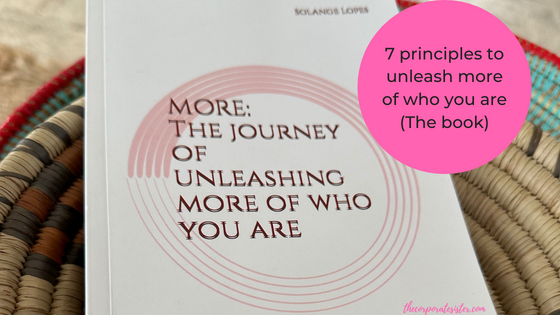
I suspect most of us have, especially as working women and mothers with so much on our plates day in and day out. Especially as the blatant lack of infrastructure supporting working women and moms often leaves us depleted…Especially as the various and oh so unfair biases affecting us, from gender stereotypes to the glass ceiling and concrete wall, leave us wanting for more fullness in our careers and businesses… These are also some of the issues I’m grappling with in my new book “More: The Journey to Unleash More of Who You Are”.
How can, and do we unleash more of who we are as working women and moms despite the obstacles facing us in and outside of work? There are 7 principles I discuss in the book as part of the conversation to answer this question:
Principle 1: Don’t miss your wake-up call wrapped as disruption
Unleashing more of who you are and what you want out of your career and life often requires you to step out of the very routine that is keeping you stuck. This often comes wrapped as unwelcome disruption at the seemingly most inconvenient times. Learning to recognize the wake-up calls wrapped as disruption is key to beginning and continuing the journey of unleashing more of who you are.
Principle 2: Begin with what you have and where you are
What keeps most of us stuck is the inability to even know where to begin in order to embark on a new journey. One of my favorite inspirational set of phrases from tennis legend Arthur Ashe is “Start where you are. Use what you have. Do what you can.” To me, it speaks to the power of small change and consistent, resilient progress. In this sense, harnessing the incredible power of your unique individual stories, skills, talents, quirks, and everything that makes you YOU becomes your very unique greatness proposition and best competitive advantage.
Principle 3: Use your season of preparation through experience and release
In line with beginning where you are and using what you have, harnessing your past experience and re-purposing your skills, talents, and story is also key to unleashing your own MORE. This also requires letting go of the version of you that no longer exists to welcome the new, evolved version of who you are becoming. This is your season of preparation.
Principle 4: Managing progress
There’s a mindset to progress and growth. One that must stand strong in the face of the backlash women experience as they dare to rise. One that must learn to celebrate progress rather than shrink and hide. Ultimately, one that knows how to manage the ebb and flow of growth and evolution while still moving forward. This mindset is indispensable to managing the progress and growth that thankfully and inevitably come as you unleash MORE of who you are.
Principle 5: Handling your season of promotion
The very promotion you may yearn for may also be terrifying to you, as it is to many, if not most working women and mothers. While being aspired to and celebrated, women’s success is also threatening to the status quo, and often rewarded by harsh backlash. This is where dealing with the fear of success and re-defining success on your own terms can make a world of difference.
Principle 6: Daring to celebrate
For working women and moms, joy and celebration constitute resistance at each step of the process of becoming their best selves. Daring to celebrate, while cultivating and preserving your joy is an act of sheer resistance.
Principle 7: Focusing on the process, not the destination
Last but not least, focusing on the process and not the destination through continuous improvement is essential. At the end of the day, it’s a marathon and not a race.
All in all, unleashing more of who you are as you get closer and closer to the fullness of who you were created to be, is a gift often wrapped in disruption and requiring a challenging, albeit rewarding, process of growth and evolution. This is a necessary and brave journey of un-becoming much of the negative and damaging stereotypes women were taught and socialized into, and instead becoming all you were meant to be.
Motherhood is beautiful. Yet, for many working mothers, especially in the US, especially in the past few years peppered with global pandemics, political and economic woes, motherhood has been “hard”. Hard is not often a word that we want to associate with being a mother, at least not one we dare to speak out loud when it comes to mothering. Yet, it certainly is the reality for many, one we soften with cute Instagram videos and funny stories, but a reality nevertheless. As many women after the COVID pandemic especially are turning to a “softer” approach to life and work, they’re also turning to a “softer” kind of motherhood. One that seeks to relieve the pressures of modern motherhood, allowing women to mother more lightly, more happily, more authentically…
I remember having a conversation with a fellow mom at my kids’ school. She laughingly was recounting how one of her daughters had told her on the ride to school one morning, that she did not want to be a mother when she’d grow up. When asked why, the young girl responded: “ Because it is so hard…” That made me think about all the times my own children may have thought the same thing. All the times our kids, nieces, or nephews look at us , between drop-offs, pick-ups, after-school activities and overflowing laundry baskets, and vow not to have children of their own, because…it looks so hard. And this is considering that most of us make it look easier than it actually is…
Many women are hitting walls of exhaustion and burnout, and bravely acknowledging it, as New Zealand’s ex-prime minister Jacinda Ardern did by stepping down earlier this year. As they do so, they are also sending the signal that things cannot keep going as they have been. Even as the world needs increased gender equity, diversity and inclusion, what it doesn’t need are mothers too exhausted to fulfill their potential in and outside of the home. Yet, with companies reneging on work-life balance measures and slowing down their diversity efforts, this is also signaling an urgent need to step back, stop glorifying the “hard” path to working motherhood, and instead re-imagining a softer way.
Often, when we hear of taking a “softer” approach, we may be tempted to think the latter would be less effective. In a society focused on over-performance at the expense of effectiveness, we’ve unfortunately come to equate “hard” with “effective”, or even “worthy”. Yet, the opposite couldn’t be truer. When it comes to motherhood, “hard” erodes the foundation of healthy mothering. Hard motherhood is motherhood that lacks flexibility, motherhood that barely survives rather than thrives, motherhood that is not full or complete, but only a shadow of its true potential. When mothers are submitted to unbearable pressure to perform, produce and deliver in the midst of a blatant lack of social, economic and political support, they are not set up for purpose, fulfillment or success. On the very contrary, they are set up for failure. And when mothers are set up for failure, families, communities and entire societies are set up for failure.
So what are we to do when ditching hard motherhood for softer mothering? In our modern society focused on productivity and results, it’s a tall order. Yet, it’s a change that can occur gradually starting with a few underrated, yet oh so effective principles:
Changing our minds about what it means to be a working mother
It all starts with mindset. For many, if not most working moms, motherhood has become an endless performance. From the wee hours of morning, to late night, they’re performing and giving of themselves without so much as a respite. The tiredness, the exhaustion, even the resentment have become a badge of honor, and the source of many acclaimed social media memes. If you’re a working mom, you must be tired. If you’re a working mom, you must not have time for self-care. If you’re a working mom, you must deny yourself, day in and day out. I remember an acquaintance telling me when my kids were still babies, that I did not look like a working mom because I was too well-put together. So does looking disheveled and piling on the under-eye concealers otherwise qualify us to be valid, worthy working mothers? Nope.
This journey towards softer motherhood begins with a changedmindset around what it means to be a working mom. It means redefining working motherhood in terms of better work-life integration, increased fulfillment and purpose. No, we don’t have to look like we’re on the brink of burnout to be approved as good mothers.
Reframe our careers and lives
The next step is to reframe our careers and lives around this mindset of fulfillment, purpose and fullness on our own terms. What are our non-negotiables? How do we take better care of ourselves in order to take better care of others? What can we take off of our plates rather than adding in? Where, and how can we get the support we need? These are a few questions to begin and continue the conversation.
Reframing our careers and lives is a matter of re-envisioning what a sustainable schedule looks like, from work obligations to kids’ activities. It is creating margins and boundaries in otherwise impossible timetables. Sometimes, it may be a matter of getting rid of the entire timetable altogether.
Taking back our power
Last but not least, softer mothering is about taking back our power to live fuller, more authentic lives that do not reflect a fraction of our potential, but as close to its entirety as possible. It’s about reclaiming the time that is so freely given away and under-estimated, and requesting the infrastructures and support needed, whether it’s childcare, flexibility or equity in the home. Finally, it’s about getting rid of the creeping, generational, overwhelming fear that keeps us from prioritizing our needs, and regaining the confidence to be the mothers we were created to be.
At the end of the day, motherhood was not supposed to be hard. Not this kind of societally-imposed, articificially-made “hard”. Is it bound to be challenging? Yes. Is it supposed to be easy? No. But this hard shell of modern motherhood that seems to be offered on the platter of “having (and doing) it all”, is not it. Rather, re-imagining a softer, effective, and sustainable approach to modern mothering is a better path to creating and sustaining societies that can thrive, and not just survive.
When we think of working women and moms, we often think of work-life balance, this elusive Eldorado of perfect (or semi-perfect) equilibrium between motherhood, work, and life in general. An elusive Eldorado that has yet to be proven true, and whose impracticality and subjective nature keep pushing working women and moms everywhere over the edge… Countless articles and arguments have been written and built around this concept, only to slowly end in the sober realization that
work-life balance for working women and moms simply does not exist…Instead, shouldn’t we focus more on work-life integration?
How can one balance the deeply personal, unpredictable and subjective journey of motherhood with the creation and nurturing of a partnership or marriage, and the demands of a purposeful career interspersed with the many obstacles all too common to working women and mothers? How can one talk about balance when your average working mom performs at least five jobs before even leaving the house in the morning? And how can there ever be a sense of balance after the way women bore the brunt of the recent COVID-19 pandemic, from the home to the business and work front?
The simple answer, after all these years of building theories and concepts around work-life balance, is that there is none after all, at least not for working women and moms. The good news? There is a link between work and life, one that can finally be beneficial for working women and moms. It is not balance, but rather an integration of the various aspects and areas of our lives as working women and mothers.
While I, as a working woman and mom, do not pretend to or even desire to balance work and life, as it would suggest an equality of weights that does not even begin to exist; I can integrate them into the ever-evolving puzzle of my life. Here are a few steps to get started:
See your life as a whole
The first step is to stop giving in to the temptation of compartmentalizing the various areas of our lives. As effective as it may sound, I have found in my own experience as a working woman and mom it doesn’t exactly work. Planning for my work schedule without taking into account the kids’ school and activity schedule is a recipe for disaster. So is considering what my priorities at home are, without taking into account my professional life. Hence why it’s so important to see our lives as a whole, with inter-dependent and integrated areas as opposed to separate and independent aspects…
Consolidate what you can
When I started really understanding how connected the various areas of my life are, I began using the power of consolidation to bring them together. I have to say, my first motive was to make my life easier. The more I was able to consolidate tasks together, the better I was able to build and maintain habits that would otherwise be unsustainable for me. For instance, when I started building my schedule to allow me to go to the gym right after dropping off the kids, building a consistent exercising habit became easier. Since I already had to be out dropping off the kids, why not wrap my exercise into this continuum of activity? The more you can consolidate your habits, tasks and ultimately your day-to-day schedule, the more you can achieve a more integrated work and life. This way, switching from one activity to another goes from being this impossible task, to just being part of a flowing schedule.
Create and maintain margins
One of the biggest problems I face as a working woman and mom is having enough margin in my schedule. Instead, I often face, as many working women and moms, a packed-tight schedule with very little breathing room. The result? Feeling a sense of always running from one thing to the other, without enough breaks in between. Ultimately, this results in a sense of going from crisis to crisis and never catching a break.
This is when intentionally creating margins and breaks in your schedule can help. When we see and approach work, life, parenting, relationships, etc, as separate blocks to attend to, we tend to want to allow as much time as possible to each, thus foregoing the necessary spaces between them we need to breathe and recover. However, when integrating work and life, we’re able to allow the various areas of our lives to flow into each other, creating the much-needed margins we crave. For me, it means limiting multi-tasking, scheduling breaks, and allowing for at least an extra ten minutes for each task.
Overall, planning for more work-life integration as a working woman and mom requires the willingness to see our lives as a whole, instead of buckets to fill up and boxes to check at the end of the day. It also demands intention and some level of planning to consolidate what we can, and create the margins we need to breathe, recover and refuel. This year and beyond, I hope we can commit to more work-life integration and allow ourselves to live fully, rather in a compartmentalized way.
How will you integrate your work and life this year?
Although it is not a tax, the “pink tax” refers to a pricing structure favoring women’s goods and services. According to BALANCE, women pay around 13 percent more for personal care items like body wash, shampoo, lotions, and perfume than men. Even razors targeted at women were 9 percent more expensive. Pink is a common hue for packaging products for women , thus the term “pink tax.”
According to the U.S. Census Bureau, full-time American women earn 83 cents for every dollar earned by males. Women have been impacted by this discrepancy all of their lives, especially women of color, from the beginning of their professions until retirement. Women also earn less in Social Security and pensions due to lower lifetime incomes than males. This is compounded by the fact women are expected to pay much more for identical products during their lifetimes than males due to lower salaries and higher expenditures on personal care items.
As a result, women tend to make less money overall due to the gender wage gap, yet still pay more than their male counterparts for the same products due to the pink tax. The fact that women often live longer than males adds an even heavier weight to these statistics.
Indeed, the average lifespan for American women is 80.5 years compared to 75 years for men. As such, women are indeed being paid less and charged more. Additionally, they also routinely endure more significant levels of stress, anxiety, social inequity, and lower income than men. This creates massive problems for women, as they end up having fewer savings to pay off debt or build emergency savings.
Another compounding factor of this blatant inequity is that while men tend to accumulate more debt than women, their financial means allow them to take prompt action to pay off debt through debt consolidation or any other debt relief options. Yet, the same thing can’t be said about women who tend to have less savings and need to be more careful about their finances and tax.
The Pink Tax Repeal Act, which “prohibits the selling of equivalent products or services that are charged differently depending on gender,” was reintroduced by Rep. Jackie Speier in June 2021. Since reopening the dialogue, some states have started campaigns to eliminate discriminatory taxes. Twenty-four states have abolished the luxury tax on products used for period care. Gender-based pricing in services like dry cleaning and hair treatment is prohibited in New York City, Miami Dade County in Florida, and California. However, these states may charge higher fees if the service demands more significant time, effort, or expense.
How to avoid paying too much on pink tax
Although the pink tax and inflation won’t go away soon, women may still take action to avoid paying too much on certain products. After all, a penny saved is a penny earned. Here are a few ways to avoid the pink tax:
Purchase gender-neutral goods
Depending on how much you favor nicely curved pink razors or flowery-scented deodorants, as well as how much math you have the time and energy to do when shopping at CVS after work, this may be simpler in principle than in practice. Since men’s and women’s items sometimes come in different sizes, you can’t always just compare costs. Instead, you should calculate the prices per ounce if it is not already stated and compare these.
Consider purchasing products that don’t require two different versions—one for men and one for women—such as shampoos, soaps, and razors. There are also several unscented men’s or gender-neutral bath products available on the market if you don’t want to “smell like a guy.”
Even certain perfumed goods for guys might appeal to ladies. Similar items are subject to the “pink tax,” although occasionally, brand or variety has a more significant impact on price. Many female-focused online merchants also provide pink tax-free personal-care goods via subscription programs if you’d rather stay with feminine alternatives. You may reduce pink tax costs with this method.
Purchase garments that don’t require dry cleaning
Purchase clothing that can be machine-washed, hand-washed, and line-dried, such as no-iron blouses. Even in states like California or Washington, DC, where it is illegal to discriminate against customers based on gender at establishments like hair salons or dry cleaners, you will still be charged extra if you want your long hair trimmed or a nice shirt cleaned.
However, it certainly isn’t easy to find apparel that is initially less expensive, especially if you’re plus-size. There is also limited recourse you have to stop certain shops from charging more for women’s clothing than men’s, other than to protest when you notice it happening.
Purchase reusable menstrual supplies
One of the most sinister aspects of the “pink tax” is that it forces women to purchase goods that men don’t need at higher prices, such as sanitary supplies for instance. While shops or manufacturers cannot legally be held responsible for this disparity, there certainly is a push out there to level the playing field in this regard. Indeed, there is a campaign to make menstruation products free for women, as well as a movement to outlaw sales taxes on tampons as they discriminate against women.
In the meantime, you may save money by utilizing reusable products like the Diva Cup, sea sponge tampons, reusable pads, or Thinx period underwear. In addition to being more environmentally friendly than single-use items, some of these goods could also be healthier to use.
Reduce your use of pricey makeup
This is likely something you already do if you feel at ease doing it. It’s also another example of how gender standards cost women more than males.
Complain against discrimination
Speak up if you see a particular manufacturer or merchant attempting to impose absurd gender pricing on unaware customers! Make a call to the corporate office or the manager. Post a review of the company on social media, contact the consumer protection office in your area, and inform your friends.
In practice, it could be more challenging to outlaw gender-based pricing for goods than services since so many variables are at play, such as packaging and marketing variations, that are acceptable justifications for corporations to charge more. Yet, businesses may change or modify some of their practices if customers cease purchasing particular goods or protest.
Develop greater discernment
It also helps being informed about price discrepancies, and going above and above to locate the most significant goods for the money, regardless of packaging. Speaking up if they notice unfair pricing is another alternative. A powerful way to voice dissatisfaction is to complain on social media, in consumer groups, to local lawmakers, and to the business as well. Consumer behavior can provide manufacturers with valuable information.
When shopping, check if there is a pricing difference between the women’s and men’s versions. If there is, check if the quantity and composition are similar. Take a photo of both goods and include the hashtag #AxThePinkTax if they are identical.
Conclusion
It’s important to remember that the pink tax is just one example of how women can be unfairly disadvantaged in the marketplace. By being aware of these issues and addressing them, we can work towards a more equitable society for everyone. It’s high time women set concrete financial goals and work on them.
Author Bio: Attorney Loretta Kilday has more than 36 years of litigation and transactional experience, specializing in business, collection, and family law. She frequently writes on various financial and legal matters. She is a graduate of DePaul University with a Juris Doctor degree and a spokesperson for Debt Consolidation Care (DebtCC) online debt relief forum. Please connect with her on LinkedIn for further information.
PS: Please note this post contains affiliate links.
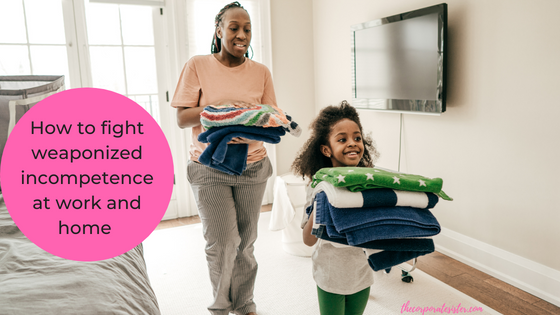
Let me ask you: When was the last time you decided to tidy up the kitchen yourself because no one else at home would do it, or do it right for that matter? How about taking over the task of organizing lunches and get-togethers in your department at work? Or even taking over the planning of events in your friend group? If you’re reading this and nodding, you probably have been the victim of weaponized incompetence, and a willing victim at that…
Weaponized incompetence was coined on TikTok and is routinely defined as the act of pretending to be incompetent at a task in order to get out of it. Usually, this is done so as to get someone else (aka the weaponized incompetence victim) to do it. It can play out in any context, from household chores to friendship-related tasks, to family dynamics and definitely work environments.
For working women and moms, this is a phenomenon that definitely plays out in the home, where mothers tend to take on the majority of the parenting and household labor three times as much as their partners, according to a McKinsey poll. This became even more apparent, and traumatic for working women and mothers, during the COVID pandemic. The pandemic also brought to light the heavy invisible labor of women leaders, from supporting Diversity, Equity and Inclusion (DEI) efforts to providing employees with emotional backing or taking on unofficial mentoring and administrative projects.
The reality about weaponized incompetence, as much as too many of us unfortunately would prefer to justify and excuse it, is that it’s nothing but an attempt to manipulate others, namely women, into doing more work than their fair share. The real danger about it as related to gender, is that it has the unfortunate tendency to victimize women and girls, seeping into their education and socialization from an early age Although it’s embedded in the artificial, man-made fabric of gender stereotypes and societal expectations, it can be addressed and fought against. Here are a few ways to do so:
Call it out!
One of the first weapons against weaponized competence is the courage to call it out, just as it is, and for what it is. Often, the perpetrators are weaponized, or strategic incompetence, do not fully realize its negative impact on its victims.
The woman leader at work who takes on unwanted DEI or administrative tasks is piling on additional labor, hours and stress that are taking a toll on her well-being and even the quality of her work. The wife who has to shoulder the majority of household tasks is crumbling under the pressure, not able to be present with her family, attend to her work and take care of herself. The friend who is constantly expected to plan all outings is prevented from enjoying the latter because of all the work she has to put in. Calling it out is the key to starting the process of fighting it!
Have an honest conversation
The first time I mentioned the concept of weaponized incompetence to my husband, he was quite taken aback. As a matter of fact, when I mention it to my male friends and family members, they’re often surprised and even tickled a bit. Yet, the more we talk about it, the more we can come to a mutual understanding.
Having an honest conversation about the load taken on by victims of weaponized incompetence, mostly working women and moms, is vital. Whether it’s discussing the mental load of planning and scheduling everything on the home front, to the time and physical load of handling household-related tasks, to the pressure of doing too much at work, being honest about the consequences and impact of weaponized incompetence is crucial. The more we pretend we’re ok taking on more responsibilities, more work with less time and resources, the less others realize what is really happening. Hence the need to have frank conversations about what this means, and how to more equitably share the load…
Now release control!
Yet, it’s not enough to just call it out and have an honest talk. Last but not least, implementing solutions discussed and releasing control are key. As working women and moms especially, we are so accustomed to doing it all that releasing control and allowing others to step in can be particularly hard. As a recovering perfectionist, letting go of the need to have things done my way was one of the biggest challenges in this process, yet one of the most freeing parts of it. It also happened to benefit my entire family, as it became an opportunity for my partner and children to learn and even start enjoying some of the tasks they had been running away from previously.
Surrendering and releasing control, even if the initial outcome if not exactly to our taste, may take some substantial trial and error. However, it is what ultimately can, and will free us, from having to suffer from weaponized incompetence.
All in all, weaponized incompetence is a phenomenon which has always existed, although it was only recently coined on social media. More than just an unfair allocation of labor, be it personal, relational or professional, it is really rooted in the patriarchal, power-based construct of our societies. The good thing is, as we’re gaining more awareness of it and its negative impact, we’re also able to counteract it in constructive and beneficial ways, not just for its victims, but for the education and bettering of all.
After becoming a mother, I started getting in the habit of setting goals for my growing family. This became all the more important as our family kept growing, and the demands of work and life in general started taking over. Achieving some semblance of balance became harder as there was an increasing amount of tasks to attend to. As a working mom, juggling the home front, work, relationships, and everything in between would at times seem like an insurmountable challenge. Without some clear goals and objectives in mind, it was next to impossible to keep up. Hence the importance of setting family goals, especially as we start a new year…
I remember reading some business and strategy books (this is one of my favorites, as well as this one, and this one too), and thinking to myself that running a family and a household ought to incorporate similar principles. There has to be a foundation and systems in place, albeit unique and less business-like, to keep it functioning as smoothly as possible. Without these, the family unit is bound to crumble under the pressure of conflicting schedules, differing personalities, career demands and multiple other sources of pressure.
Setting family goals is not much different than setting any other types of goals, from personal to work and even financial goals. However, it does involve a greater level of complexity due to the sheer number of individuals, personalities and opinions involved. For family goals to truly be effective, they have to involve everyone and take into account each and every unit of the family. This can make for a monumental task at hand, and possibly a breeding ground of disagreements.
So how do we get to set effective family goals that involve everyone and can be achieved individually and as a family unit? Here are three tips that may help:
Start with a process of self-introspection
Yes, family goals involve the entire family. However, since the family is made up of separate individuals, it also requires each person to go through a process of self-analysis and introspection to determine what their vision of the family is.
When we started setting family goals in my own family, my husband and I quickly realized that coming from different cultural and personal backgrounds had us define the concept of family in very different ways. It was important for us to first think about what our own view of family was, in order to bring it to the table and discuss. It was also important to involve the children in this process, by inviting them to journal about their own family goals (this is an excellent journal for kids by the way).
Meet and discuss
Family goals are for the entire family, and do require the entire family’s contribution, including the children, as long as they are old enough to participate. Coming together with everyone’s view of what the family should be like, how it should operate, what the rules should be, and so many other factors, is a game-changer. This is where ground rules can be set, an effective foundation can be built, and where respect and consideration for all can be demonstrated.
This is also where fundamental disagreements can arise, which is also beneficial to identify where there is a need to set a different foundation. Some of the topics discussed can range from respect, health, responsibilities, religion, finances, communication, to time management, education and purpose.
Decide on the best goals for YOUR family
Setting family goals is not about reaching an ideal and elusive set of grand objectives for the family. Rather, it’s really about coming together and sharing what works best for YOUR family. No two families are alike. As much as we would like to replicate the organizational skills of this family, or the glamour of that family, the reality is, each family is beautifully unique. This is why it’s so important to focus on the goals that are appropriate, realistic and achievable for your family. It may mean starting with just waking up on time for school, or setting up a basic family calendar (check out this well-reviewed family calendar, as well as this More Time Moms Family Organizer too), or having a set budget,( you can use this Simplified Monthly Budget Planner, or this Monthly Finance Organizer) as opposed to launching into extra volunteering activities or investing in the stock market. Whatever it is, it has to be aligned with the type of family YOU have, its vision as well as its heart.
All in all, setting family goals is a crucial part of the goal-setting process as the new year begins. It involves partaking in a process of self-introspection, coming together to discuss, and finally deciding on the best goals for one’s family.
Do you set family goals at the start of the New Year?
With gratitude,
The Corporate Sis.
PS: Please note this post contains affiliate links.
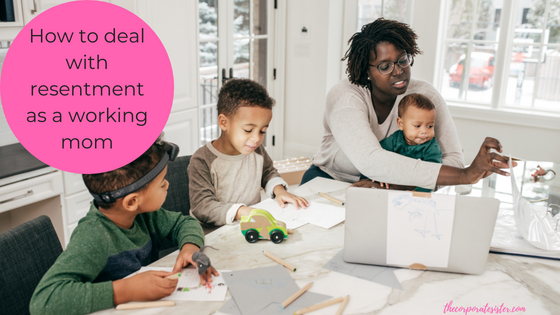
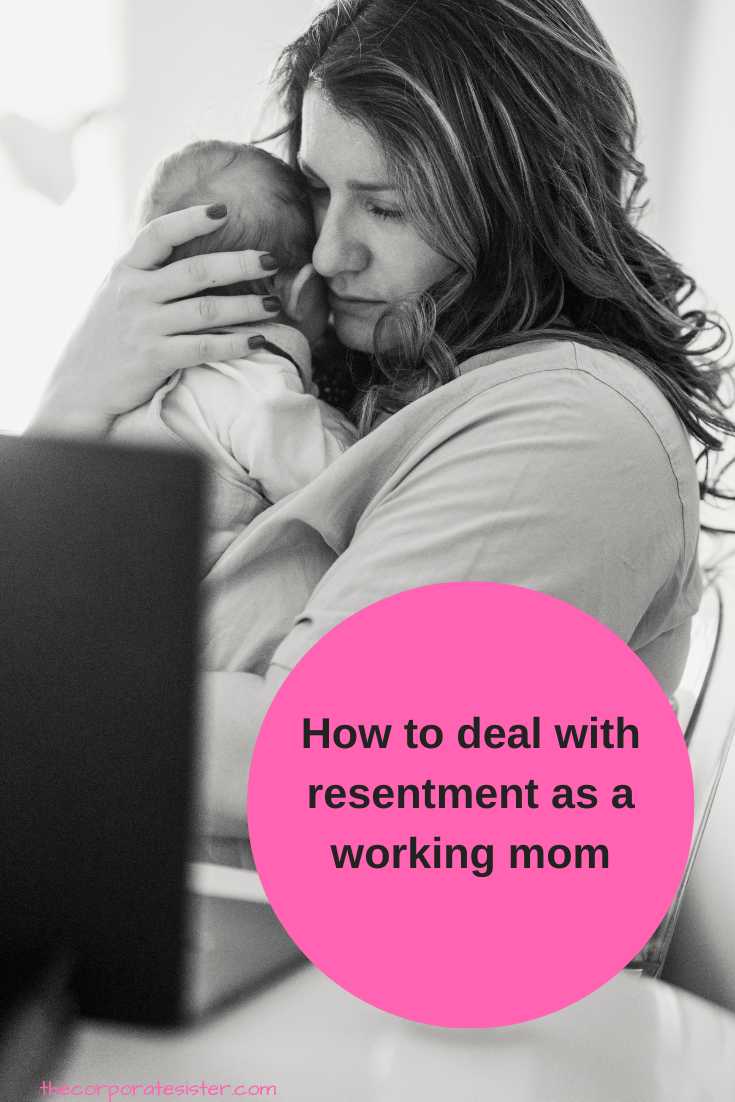
How many times as a working mom have you felt a wave of resentment come up at the thought of everything you have to do day in and day out?
And how many times has this resentment made you feel guilty as a result?
Further, let me ask you, how many times have you even dared talking about this feeling of resentment to anyone for fear of being negatively judged?
If you’re nodding at any of these questions, you’re certainly not alone.
Resentment is one of the best well-kept secrets about and among working moms. As working mothers are hailed, praised, and kept, by society as “sheroes”, they’re also not allowed to show weakness, and certainly not resentment. Instead, they are expected to hold up the sacred veil of motherhood, bravely (and flawlessly) handling all the responsibilities assigned to them without a complaint, murmur or negative feeling. Being resentful as a working mom is perceived as a threat to this picture-perfect idealization of womanhood, and as such, is considered a big no-no for many, if not most, working women.
Yet, the reality is, as we pick up dirty socks off the floor, wash dishes, run from work to kids’ activities, forgetting to fill this or that form, it’s virtually impossible for many, if not most working moms, to experience if only a touch of resentment at some point or another. This is especially true when there is a lack of gender equity in the home and at work, and women have to face a staggering lack of resources and support, from childcare to work flexibility.
So what do you do when resentment rears its ugly head in the midst of your unending to-do list and tired self? How do you address the subtle anger rising up in you as you consider one obstacle after another standing before you? Here are some tips that may help:
Stop and reflect!
Resentment is a clear indicator that there is a lack of balance somewhere. I’ve found over the years that our bodies and minds will give us distress signals. However, too often, we fail to listen. This is where pausing to listen to ourselves is important.
Why am I feeling so resentful? What is creating this feeling in me?
Identifying the root cause of resentment can go a long way towards addressing what the real issue is. Oftentimes, we feel resentful because of false beliefs, or because we’ve taken on too much, or we feel unappreciated in one or many areas of our lives and work.
What is making you feel resentful as a working mom?
Resentment is not a dirty secret to lug around and hide from everyone around us. Neither does it make us bad mothers. It simply makes us human, and allows us to heal what is festering inside us. This is where communication, effective communication that is, comes in handy.
Communicating how you feel, in a non-blaming way, whether it is to your partner, family or friends, can help them better understand where you’re coming from. It can also help in solving the imbalance you may be experiencing, whether it’s related to the lack of equity at home, or the stress in your career and/or relationships.
Who can you trust to talk it out and communicate how you’re feeling?
Readjust
Last but not least, while reflection and communication are important, action is indispensable to readjust the lack of balance causing the resentment you’re feeling. It may be readjusting the distribution of responsibilities and chores in the household, or looking to make positive changes in your career, or asking for more support in your relationships. It’s often also a matter of re-centering yourself and taking better care of yourself through self-care. Whatever the need may be, taking action on it can help reduce the feelings of resentment you’re experiencing.
How can you readjust your schedule, work and life to feel less resentful?
In conclusion, feeling resentful as a working mom is not a sign to blame yourself or others. It’s a powerful signal to re-establish more balance, joy and health in your work and life. Pausing to reflect, talking it out and readjusting as needed are three effective steps that can help tremendously in the process.
How are you dealing with feeling resentful as a working mom?